
GPUaaS for AI Workloads in Australia: Build Sovereign AI Capability You Actually Control
18 Jun 2026, by James Braunegg, CEO and Founder, Micron21
Everyone is in love with large language models and generative AI right now, and rightly so. The technology is genuinely transforming how businesses write, code, support customers, analyse documents and make decisions. But underneath the excitement sits a question that very few people have answered honestly: who can actually see your data, where does it physically live, and what happens to it once it leaves your building?
That uncertainty is driving one of the most important infrastructure trends I have seen in twenty years of running a data centre. Organisations are no longer content to pour their most sensitive information into a public AI endpoint and hope for the best. They want to build and run their own AI capacity on hardware they control, in a country whose laws they understand, with a clear answer to the question "where is my data right now?" That is exactly what GPU as a service in Australia is designed to deliver, and it is why we built our dedicated GPUaaS platform at Micron21.
What GPU as a service actually means
GPU as a service, or GPUaaS, is the ability to access enterprise grade graphics processing units on demand, billed as an operating expense, without buying the hardware outright or waiting months for it to arrive. Instead of spending hundreds of thousands of dollars on NVIDIA accelerators that may be superseded in eighteen months, you rent exactly the GPU capacity your workload needs, scale it up when a training run demands it, and scale it back down when the job is done.
The difference with our platform is that we deliver GPUaaS Australia wide, on infrastructure we own and operate inside the country, rather than reselling capacity from an offshore hyperscaler. When you run an AI workload with us, the silicon is sitting in our Tier IV certified data centre in Melbourne, connected to our own global network, protected by our own DDoS mitigation, and governed by Australian law. You get the same NVIDIA GPU technology the big public providers use, but the environment around it is yours.
We offer GPUaaS two ways, because no two AI projects look the same.
The first is on our physical dedicated servers. This is raw, bare metal access to the hardware. We build the server to your exact specification, the precise CPU core count, the memory, the storage and the GPU cards you need, and it is entirely yours. You can run any operating system, any hypervisor, any software stack, in either Linux or Windows depending on your application. Nothing else runs on that machine. For teams that need guaranteed performance, full hardware isolation, and the ability to fine tune at the kernel level, dedicated GPU servers are the gold standard.
The second is through mCloud, our cloud platform. Here you add direct GPU capacity to a virtual environment that is built with no single point of failure, spanning multiple physical hosts and storage devices. You can start small, add a single A10 to an existing instance, and scale up to multi GPU configurations as your models and datasets grow. mCloud gives you the flexibility and redundancy people expect from a cloud server, with the sovereignty of knowing every node sits inside our Australian facility.
In both cases the principle is the same. You define exactly the type and amount of sovereign GPU capacity you require, and you keep direct control over your AI technology.
Choosing the right card: A10, A100, H100 and H200
One of the most common mistakes I see is teams reaching straight for the most powerful, most expensive GPU when a smaller card would do the job at a fraction of the cost, or the reverse, trying to squeeze a 70 billion parameter model onto hardware that simply cannot hold it. Matching the GPU to the workload is where real money is saved, so here is how I think about the four NVIDIA cards we offer.
The NVIDIA A10 is the workhorse for inference and virtualisation. Built on the Ampere architecture with 24GB of GDDR6 memory, 10,752 CUDA cores and third generation Tensor Cores, it delivers around 31 teraFLOPS of FP32 and up to 250 INT8 TOPS. It draws only 150 watts, and a single A10 can support up to 32 users in a virtual desktop environment. For serving small to mid sized language models in the 7 billion to 13 billion parameter range, running computer vision, powering virtual workstations, or handling steady production inference, the A10 is outstanding value. It is the card most businesses should start with.
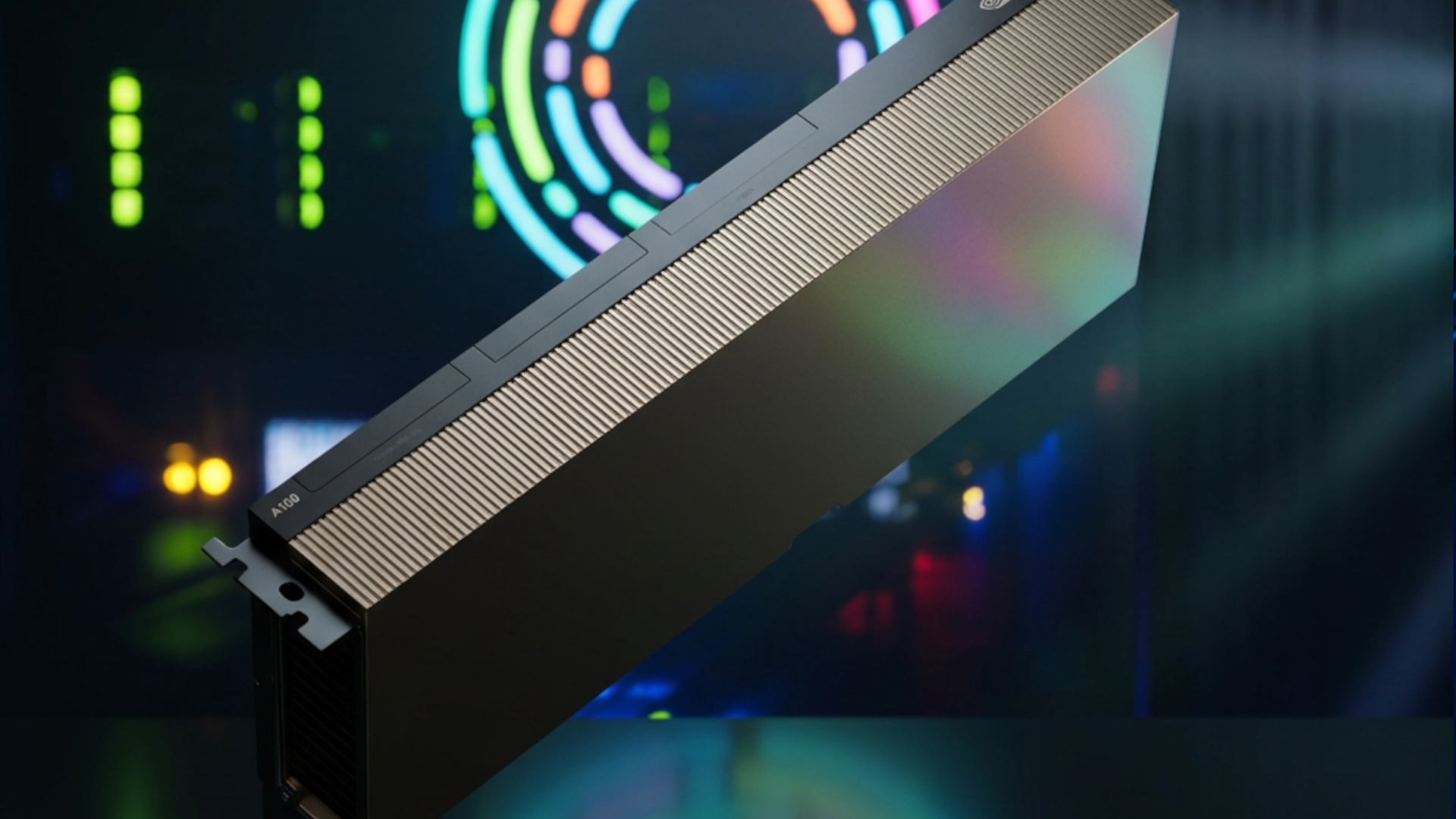
The NVIDIA A100 is the proven choice for serious training and mid scale inference. It comes in two memory configurations, and both are excellent value. The A100 40GB is a genuinely cost effective entry into data centre class training and inference, ideal when you need far more capability than an A10 but do not need the full 80GB, and for many teams it hits the best balance of price and performance in the whole range. The A100 80GB, with HBM2e memory and just over 2TB per second of bandwidth, comfortably handles the larger models and datasets the 40GB card cannot. As the industry benchmarks put it, the A100 delivers eighty to ninety percent of what most teams need at roughly seventy percent of the cost of the newest cards. Whichever variant you choose, the A100 is the sensible backbone of a sovereign AI platform.
The NVIDIA H100 is the Hopper generation step change. It pairs 80GB of HBM3 memory with up to 3.35TB per second of bandwidth and a transformer engine purpose built for large language models. For training models above 70 billion parameters, or for distributed training across multiple nodes, the H100 is the recommended configuration. If you are doing frontier scale work, this is where it happens.
The NVIDIA H200 shares the Hopper architecture of the H100 but transforms its memory subsystem, carrying 141GB of HBM3e, roughly seventy six percent more than the H100, with bandwidth around 4.8TB per second. That extra memory unlocks workloads that were previously impractical: models above 100 billion parameters, very long context inference, retrieval augmented generation over large knowledge bases, and large batch training without constantly running out of VRAM. When the size of your model or your context window is the bottleneck, the H200 is the answer.
Having this full range, from the efficient A10, through both the A100 40GB and 80GB, all the way up to the H100 and H200, is the point. It means you are not forced into a one size fits all decision. You define exactly the right type of sovereign GPU capacity you require, and you can mix cards across workloads as your needs evolve.
A tokenless platform: run your own models, keep your own data
Here is the part that matters most to me. When you run your AI on our GPUaaS platform, you are running your own models. You can deploy from the enormous and rapidly improving catalogue of open weight large language models and open source software, Llama, Mistral, Qwen, DeepSeek and many more, using mature serving frameworks like vLLM and Ollama. You can fine tune them on your own data, quantise them to fit your hardware, and merge them to suit your domain.
This gives you a tokenless platform. There is no per token API bill metering every word your business generates, and just as importantly, there is no third party sitting in the middle of every query your staff and customers make. Above sustained usage of a few million tokens a day, running your own GPUs is also simply cheaper than paying public API rates, so for any organisation using AI at scale the economics increasingly favour owning your inference.
The contrast is worth stating plainly. Public providers such as Claude, OpenAI and Gemini deliver genuinely excellent AI, but it is public AI technology accessed over someone else's infrastructure, on their terms, in their jurisdiction. Running your own infrastructure isolates you entirely to your own physical environment while still using the same class of NVIDIA GPU technology underneath. You get a local, sovereign solution, the capability of frontier AI with none of the questions about where your prompts, your documents and your fine tuning data end up.
Sovereign cloud and sovereign capability: why this matters in Australia
Data sovereignty has moved from a compliance footnote to a board level concern, and AI has accelerated that shift dramatically. Australian organisations are expected to spend more than 33 billion dollars on public cloud services in 2026, and a growing share of that demand is specifically for sovereign cloud, platforms with Australian data residency where sensitive information stays under national jurisdiction.
The regulatory direction is clear. Government and regulated entities running workloads up to and including the Protected level need infrastructure assessed against the Australian Government Information Security Manual. From December 2026, organisations using automated decision making must disclose in their privacy policies how AI is used to make decisions. Hybrid approaches, keeping sensitive data and AI workloads on sovereign infrastructure while still using public cloud for elastic, non sensitive tasks, now lead the market precisely because they let organisations meet these obligations without giving up flexibility.
This is what sovereign capability really means. It is not a marketing word. It is the practical ability to run advanced AI inside Australian borders, on infrastructure operated by an Australian company, with a clear chain of custody over your data and your models. A sovereign cloud is one where you can answer, with certainty, where your data lives, who can access it, and which laws apply to it. When you build your AI on our GPUaaS platform, those answers are simple and they are Australian.
Where sovereign GPUaaS earns its keep: real use cases
The reason I push so hard on control is that the highest value AI use cases are almost always the most sensitive ones. Here is where I see sovereign GPU as a service in Australia making the biggest difference.
In healthcare, hospitals and medical providers want to summarise patient notes, assist with diagnosis, and search clinical literature, but patient data cannot leave a controlled, compliant environment. A private model running on dedicated A100 or H100 capacity lets clinicians use AI without a single record touching a public endpoint.
In legal and professional services, firms are using retrieval augmented generation to query decades of case files, contracts and advice. That corpus is privileged and confidential. Running an H200 backed model over a private knowledge base keeps the entire pipeline, documents, embeddings and prompts, inside the firm's sovereign environment.
In financial services, banks, insurers and fintechs face strict obligations around data residency and automated decision making. Sovereign GPUaaS lets them build fraud detection, document processing and customer service models on infrastructure that satisfies regulators and keeps customer data onshore.
In government and defence, the requirement is non negotiable. Workloads must run on assessed, Australian operated infrastructure. Sovereign GPU capacity makes it possible to adopt modern AI without compromising on security classification or jurisdiction.
Beyond the regulated sectors, I see manufacturers and engineering firms fine tuning models on proprietary designs they would never upload to a public service, software companies running private coding assistants over their own codebase, media and creative studios using A10 capacity for rendering and content generation, and a fast growing wave of organisations building agentic AI systems, autonomous agents that read internal systems and take actions, where keeping the whole loop inside a controlled environment is essential. In every one of these cases the common thread is the same: the AI is valuable precisely because it is trained and run on data too important to hand to someone else.
The foundation underneath the GPUs
A GPU is only as good as the environment around it, and this is where two decades of building Micron21 comes together. Our GPUaaS platform does not sit in a rented cage. It runs inside our own Tier IV certified data centre in Melbourne, the highest tier of resilience, with full redundancy across power and cooling. It is connected to our own global network, AS38880, one of the largest peered networks in Australia, peering with more than 2,000 networks. It is protected by the DDoS mitigation platform we have spent more than fifteen years developing, delivering layer 3, 4 and 7 protection. And it is watched around the clock by our own SOC and NOC teams.
You cannot, as I often say, operate a Tier IV data centre and not secure the network at the same time. The same applies to AI. There is little point running a sovereign model if the infrastructure underneath it is fragile or exposed. Owning and operating the whole stack, the data centre, the network, the security and the cloud platform, is what lets us offer hyperscale style GPU capability with genuine sovereign assurance.
To make adoption straightforward, GPU capacity comes with our full range of customer care options, from self managed through to reactive and fully proactive support, so you can choose how much of the operational load you want to carry yourself and how much you want our engineers to handle. Whether you want bare metal you administer entirely, or a fully supported managed environment, the choice is yours.
Build your own AI, on your own terms
The organisations that will get the most out of this technology over the next decade are the ones that treat AI as core infrastructure rather than a feature they rent. Owning your GPU capacity, running your own models, and keeping your data inside a sovereign Australian environment is how you turn AI from a risk you manage into a capability you control.
If you are weighing up how to run AI workloads safely in Australia, whether you need a single A10 to serve a model in production, a cost effective A100 40GB to get started with real training, or a cluster of H100 and H200 cards for serious work, I would genuinely like to help you get it right. Talk to us about GPUaaS on dedicated servers or mCloud, and we will help you define exactly the sovereign GPU capacity your workload needs. Australia needs more of its AI future built and kept at home, and that is exactly what we are here to do.
See live configurations and pricing, and build the exact GPU server you need, with our GPU cloud server calculator:
Open the Micron21 GPU cloud server pricing calculator
