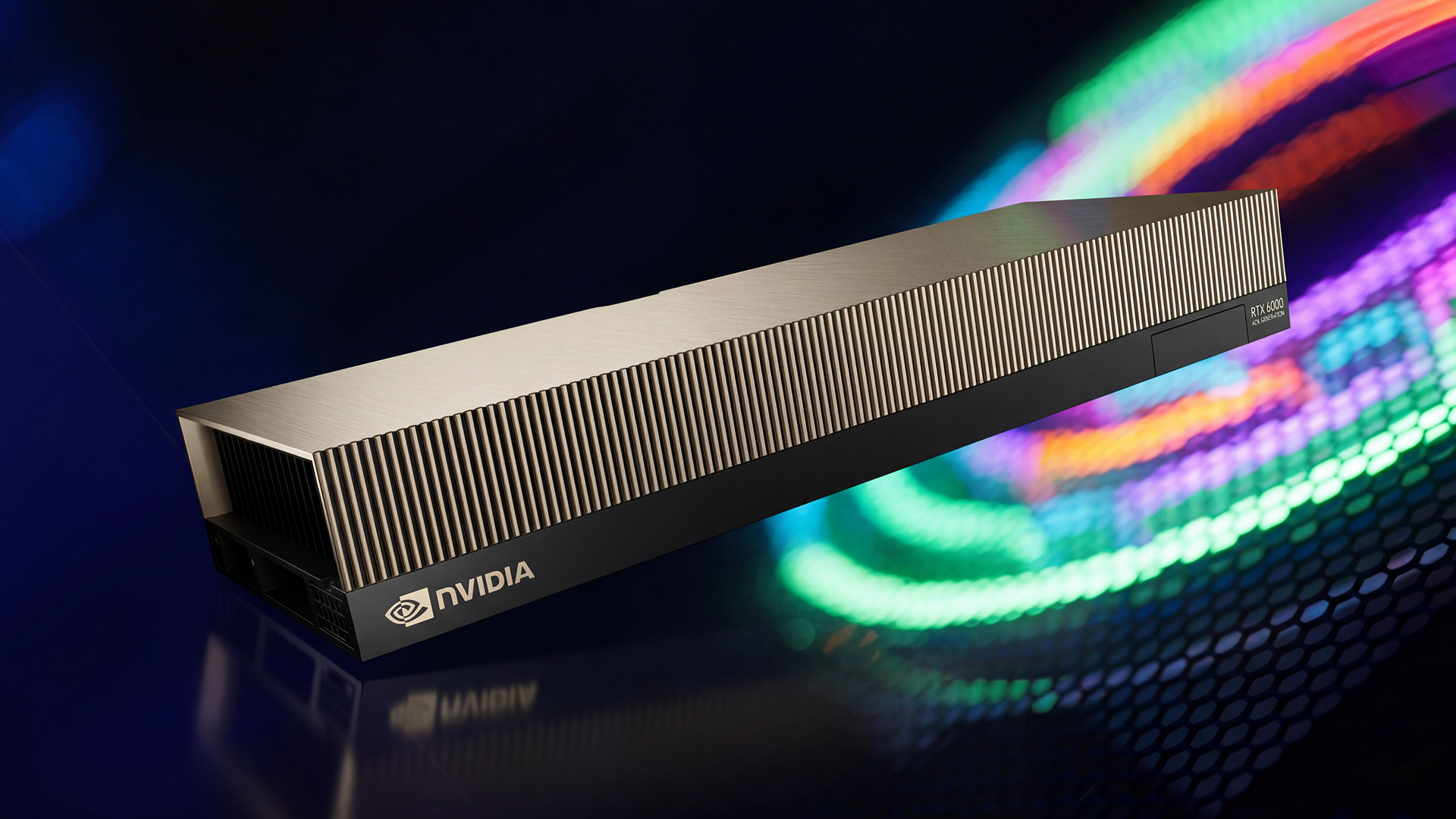

NVIDIA RTX PRO 6000 Cloud Pricing in Australia (2026): mCloud vs AWS, Azure, Google and Neoclouds
08 Jul 2026, by James Braunegg, CEO and Founder, Micron21
This is the latest in our series comparing mCloud GPUs against the global market, after the NVIDIA A100 and NVIDIA H200. This time the card is the NVIDIA RTX PRO 6000 Blackwell Server Edition, the professional Blackwell GPU with 96GB of GDDR7, and the conclusion is the most straightforward yet: on price, mCloud is squarely mid-market, cheaper than both AWS and Google Cloud, and a fair rate for a current-generation card; and on everything the price does not capture, sovereignty, a complete instance, and Australian ownership, it is the strongest sovereign option in the country.
As always we show the full market, including the providers that are cheaper than us, because a comparison that hides its competition is not worth reading. The RTX PRO 6000 is widely available: AWS and Google Cloud both offer it directly, and a dozen neoclouds do too. So unlike the H200 there is no 8-GPU trap and no "only Australian option" story to lean on. The case for mCloud on this card is simpler and, we think, more convincing precisely because it does not need those crutches: a competitively-priced, current-generation 96GB Blackwell GPU, in a complete dedicated instance, hosted sovereign in Australia, cheaper than every hyperscaler, and billed in Australian dollars.
What the RTX PRO 6000 Blackwell is
The NVIDIA RTX PRO 6000 Blackwell Server Edition is NVIDIA's flagship professional GPU on the Blackwell architecture. It carries 96GB of GDDR7 memory (the largest VRAM of any single professional card), 1,792 GB/s of bandwidth, 24,064 CUDA cores, 5th-generation Tensor Cores with FP4 support, 4th-generation RT cores, PCIe Gen 5, and a 600W board. That is a very different animal from the previous Ampere-generation RTX A6000 (48GB, 2020) that shares part of its name; the Blackwell card roughly doubles the memory, adds FP4, and multiplies AI throughput.
What it is built for is large-VRAM single-GPU work. The 96GB lets a single card hold models and datasets that used to need two or more GPUs: comfortably a 30B-parameter model in FP16, or a 70B-class model in 4-bit or 8-bit quantised form, all in one card with no sharding. That makes it excellent for local and on-premises-style AI inference and fine-tuning, professional visualisation and rendering, media and VFX, and virtual workstations. One design choice matters for planning: the RTX PRO 6000 is PCIe-only with no NVLink, so it favours single-GPU and lightly-parallel workloads over large distributed training jobs, where a data-centre card like the H200 with NVLink is the better fit. In short, it is the card you choose when you need a lot of memory on one GPU rather than many GPUs stitched together.
RTX PRO 6000 Blackwell Server Edition: key specifications
| Specification | NVIDIA RTX PRO 6000 Blackwell Server Edition |
|---|---|
| Architecture | NVIDIA Blackwell |
| GPU memory | 96GB GDDR7 with ECC |
| Memory bandwidth | 1,792 GB/s |
| Memory interface | 512-bit |
| CUDA cores | 24,064 |
| Tensor cores | 5th generation (FP4 support) |
| RT cores | 4th generation |
| Single-precision (FP32) | 125 TFLOPS |
| System interface | PCIe Gen 5.0 x16 |
| NVLink | No (PCIe-only) |
| Total board power | Up to 600W |
| Release | 2025 |
RTX PRO 6000 Blackwell vs RTX 6000 Ada vs RTX A6000
NVIDIA has now released three generations of professional "6000" cards, and the similar names cause real confusion. They are very different GPUs, and a quote or benchmark for one tells you almost nothing about another. If you are comparing prices or specifications, confirm you are looking at the Blackwell RTX PRO 6000, not the older Ada or Ampere cards, because the gap in both capability and cost is enormous.
| GPU | Architecture | VRAM | Memory | Bandwidth | CUDA cores | Released |
|---|---|---|---|---|---|---|
| RTX PRO 6000 Blackwell | Blackwell | 96GB | GDDR7 ECC | 1,792 GB/s | 24,064 | 2025 |
| RTX 6000 Ada | Ada Lovelace | 48GB | GDDR6 ECC | 960 GB/s | 18,176 | 2022 |
| RTX A6000 | Ampere | 48GB | GDDR6 ECC | 768 GB/s | 10,752 | 2020 |
The Blackwell RTX PRO 6000 that mCloud runs doubles the memory of both older cards to 96GB, moves to faster GDDR7, more than doubles memory bandwidth over the Ampere A6000, and adds FP4 precision for dramatically higher AI inference throughput. It is the card to choose when you need the most VRAM available on a single professional GPU, and it is the card mCloud provisions, not the earlier Ada or Ampere parts some providers still list under the "6000" name.
The price comparison, in full
Here is the global market for a single RTX PRO 6000 Blackwell, July 2026, on-demand list prices, normalised to a 720-hour month in US dollars. To compare like with like, the mCloud bar shows the GPU component of the instance (A$2,550/month, about US$1,796), since every other row is also a bare GPU rate; the full mCloud instance including CPU, RAM, storage and data is A$3,030 (about US$2,134).
| Provider | US$/GPU-hr | US$/GPU/month | Type | Hosted |
|---|---|---|---|---|
| Vast.ai (marketplace) | $1.42 | ~$1,022 | Marketplace | Global, variable |
| Nebius | $1.80 | ~$1,296 | Neocloud | US/EU |
| Hyperstack | $1.85 | ~$1,332 | Neocloud | EU/US |
| RunPod (Secure Cloud) | $2.09 | ~$1,505 | Neocloud | US/EU |
| Sesterce | $2.15 | ~$1,548 | Neocloud | US/EU |
| Koyeb | $2.20 | ~$1,584 | Neocloud | US/EU |
| mCloud (Micron21), GPU rate | ~$2.49 (A$3.54) | ~$1,796 (A$2,550) | Sovereign dedicated | Australia, Tier IV Melbourne |
| CoreWeave (8x node) | $2.50 | ~$1,800 | Neocloud | US/EU |
| Modal | $3.03 | ~$2,182 | Neocloud | US |
| AWS (g7e.2xlarge) | $3.36 | ~$2,419 | Hyperscaler | Global |
| Google Cloud (g4-standard-48) | $4.50 | ~$3,240 | Hyperscaler | Global |
Prices for AWS, Google Cloud, Vast.ai, Nebius, RunPod, CoreWeave and Modal are verified full-instance on-demand rates (Thunder Compute, July 2026). Hyperstack, Sesterce and Koyeb are whole-GPU on-demand rates from the GetDeploying index, consistent with the verified neighbours but not independently confirmed. Both hyperscalers price above mCloud; AWS rises to US$4.14-5.26/GPU on larger g7e configs (see the section below on how their pricing works). Azure lists the card as the NC RTX PRO 6000 BSE v6 series in public preview, so it is not included in the ranking above. mCloud GPU rate is A$2,550/month; the full instance with 12 vCPU, 64GB RAM, 500GB NVMe, 2TB data and DDoS is A$3,030 (~US$2,134). 1 USD = 1.42 AUD.
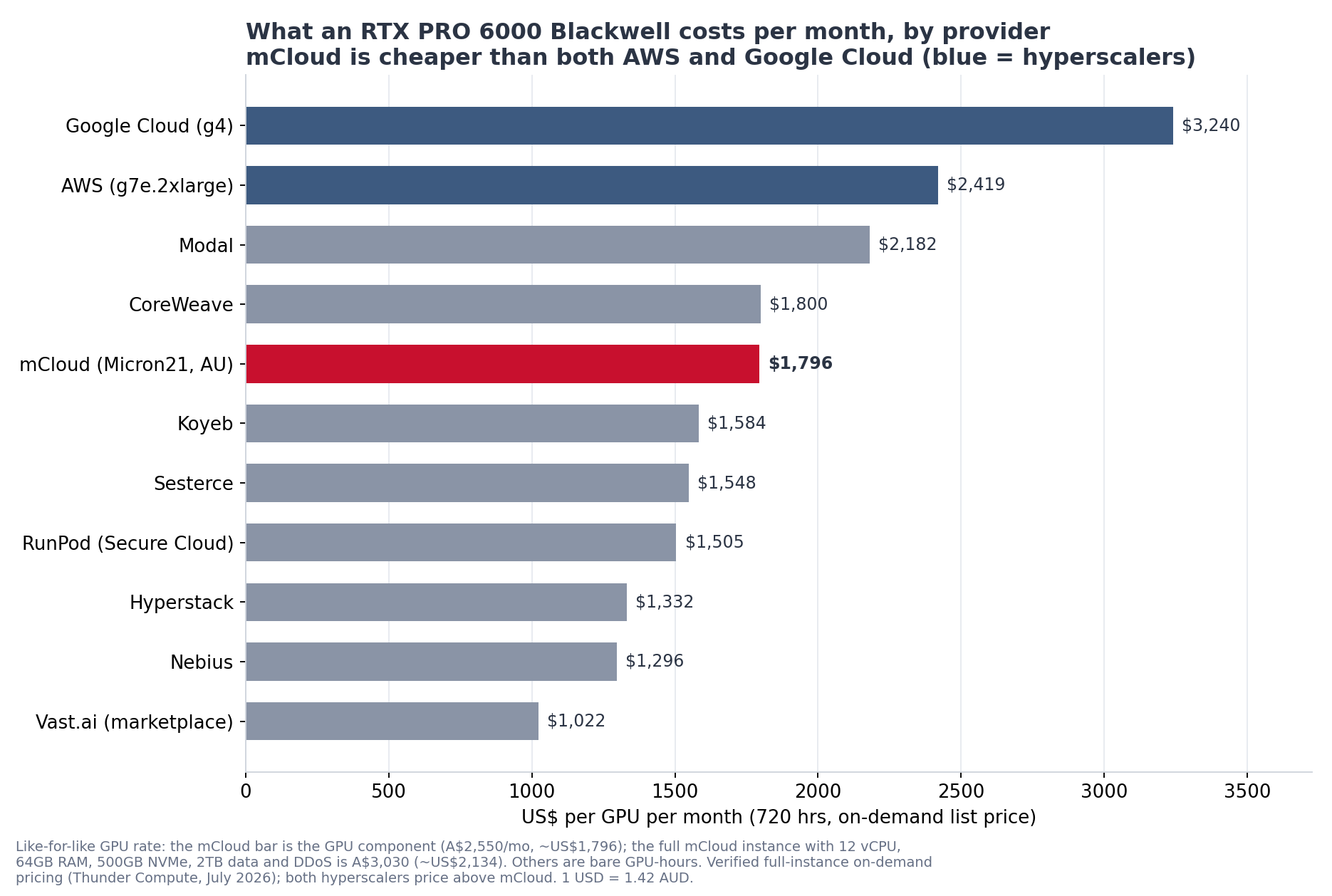
The honest read: mCloud's GPU rate lands squarely mid-market, level with CoreWeave, comfortably below Modal, and cheaper than both hyperscalers that publish this card, AWS (about 26 percent below) and Google Cloud (about 45 percent below). It is dearer than the budget neoclouds (Vast.ai, Nebius, Hyperstack, RunPod, Sesterce, Koyeb), which is where the cheaper options genuinely are. So on raw price mCloud is neither the cheapest nor the most expensive; it is a fair, mid-market rate for a current-generation card that undercuts every hyperscaler offering it. That is a strong position, and the honest one.
Why the hyperscaler prices you see are misleading
It is easy to assume the big clouds are cheaper on this card, because the popular price-comparison sites often report them at a fraction of their real rate. Google Cloud, for instance, is frequently listed around US$1.10 per hour, when the true rate for one whole card is US$4.50, more than four times higher. Before you take any hyperscaler figure at face value, here is exactly how each one prices this card and why the number a comparison tool shows you can mislead.
Google Cloud g4: fractional-GPU shapes
Google's g4 machine family scales vCPUs and a fraction of a GPU together. The smaller shapes give you a slice of a card, not a whole one, and a comparison tool that reads a small shape's low total and labels it "1x RTX PRO 6000" understates the price fourfold.
| Shape | GPUs | vCPU | RAM | US$/hr | Per whole GPU |
|---|---|---|---|---|---|
| g4-standard-6 | 0.125 | 6 | 22GB | $0.56 | $4.49 |
| g4-standard-12 | 0.25 | 12 | 45GB | $1.12 | $4.50 |
| g4-standard-24 | 0.5 | 24 | 90GB | $2.25 | $4.50 |
| g4-standard-48 (one full GPU) | 1 | 48 | 180GB | $4.50 | $4.50 |
| g4-standard-96 | 2 | 96 | 360GB | $9.00 | $4.50 |
The effective rate is a flat US$4.50 per whole GPU-hour across every shape. The US$1.10 figure that fooled us was the g4-standard-12 total, which is a quarter of a GPU. One whole card is US$4.50, the most expensive rate in the entire market. So the rule is simple: on Google Cloud, only the g4-standard-48 and its multiples give you a whole card, and the price is always US$4.50 per GPU.
AWS g7e: one GPU, several prices
AWS does not use fractional GPUs, but it attaches vCPU and RAM to a single card in fixed steps, so one RTX PRO 6000 costs anywhere from US$3.36 to US$5.26 depending on how much CPU and memory comes bundled. There is no single "AWS price"; the entry rate flatters it, and a realistic workload configuration sits higher.
| Shape | GPUs | vCPU | RAM | US$/hr | Per GPU |
|---|---|---|---|---|---|
| g7e.2xlarge (entry) | 1 | 8 | 64GB | $3.36 | $3.36 |
| g7e.4xlarge | 1 | 16 | 128GB | $3.99 | $3.99 |
| g7e.8xlarge | 1 | 32 | 256GB | $5.26 | $5.26 |
| g7e.12xlarge | 2 | 48 | 512GB | $8.29 | $4.14 |
We used the most favourable AWS number in our comparison, the US$3.36 entry tier, but that comes with only 8 vCPUs, which is light for a 96GB GPU; a realistic single-card config (g7e.8xlarge, 32 vCPU) is US$5.26, and the per-GPU rate on multi-GPU nodes is US$4.14. Even at the flattering entry rate, AWS is above mCloud.
Then add the parts that never appear in the sticker on either one: both bill compute only, in US dollars, with data egress metered on top (AWS charges US$0.09 per GB after a small free tier), plus storage and support as separate line items. So the real, all-in, realistic-configuration hyperscaler price for a single RTX PRO 6000 is well above mCloud's fixed A$3,030 full instance, before currency risk is even counted. The lesson for anyone comparing GPU prices: normalise to one whole GPU, in a realistic configuration, all-in, in your own currency. Do that, and both hyperscalers land clearly above mCloud, not below it.
The hyperscalers offer this card too, so what actually separates mCloud
With the H200 the decisive structural fact was the 8-GPU minimum. The RTX PRO 6000 has no such trap: AWS (the g7e family), Azure (NC RTX6k v6) and Google Cloud (g4) all sell it as a single GPU and scale up in ones and twos. So single-card flexibility is not a differentiator here; the hyperscalers have it too. What separates mCloud on this card is therefore not availability but the combination the hyperscalers structurally cannot offer an Australian buyer:
- Sovereignty. mCloud is 100 percent Australian owned and operated, in an Australian Tier IV facility, under Australian law. AWS, Azure and Google are foreign-owned platforms; even where they run the card in an Australian region, the operator and jurisdiction are not sovereign.
- Cheaper than every hyperscaler. mCloud is about 26 percent below AWS and 45 percent below Google Cloud per GPU, before their separate storage, egress and support charges are added. On this card the hyperscalers are the most expensive options in the market, not the cheapest.
- A complete instance in Australian dollars. The mCloud price is fixed, ex GST, and bundles CPU, RAM, NVMe, data and DDoS; the hyperscaler rate is compute only, in US dollars, with everything else metered.
- Dedicated hardware and local support. A guaranteed dedicated card, a published SLA, and Australian engineers on site, not a shared tenancy and a support tier.
The genuinely cheaper options for this card are the offshore neoclouds (Vast.ai, Nebius, Hyperstack, RunPod and similar), not the hyperscalers; if the lowest GPU rate is your only criterion and sovereignty is irrelevant, those are worth a look. But for an Australian organisation weighing the whole picture, a mid-market price that beats every hyperscaler, in a sovereign Australian instance with everything included, is a strong position.
One card to eight: how mCloud RTX PRO 6000 pricing scales
Like every mCloud GPU, the RTX PRO 6000 scales from one to eight dedicated cards on a single instance, with resources scaling alongside. The published configurations, ex GST:
| Configuration | 1x | 2x | 4x | 8x |
|---|---|---|---|---|
| RTX PRO 6000 Blackwell (96GB each) | 1 ($2,550) | 2 ($5,100) | 4 ($10,200) | 8 ($20,400) |
| vCPU cores (Xeon Gold) | 12 | 24 ($240) | 48 ($480) | 96 ($960) |
| Memory / RAM | 64GB | 128GB ($320) | 256GB ($640) | 512GB ($1,280) |
| mSAN Performance NVMe | 500GB | 500GB ($140) | 500GB ($140) | 500GB ($140) |
| Metered data included | 2TB ($50) | 2TB ($50) | 2TB ($50) | 2TB ($50) |
| IP + DDoS protection | Included | Included | Included | Included |
| Total per month (ex GST) | A$3,030 | A$5,860 | A$11,520 | A$22,840 |
| Effective price per card | A$3,030 | A$2,930 | A$2,880 | A$2,855 |
Contract length 12 months, billed monthly, self-managed with self setup; managed care plans available. Total VRAM: 96GB, 192GB, 384GB and 768GB of GDDR7. PCIe-only (no NVLink), so each card is an independent 96GB device.
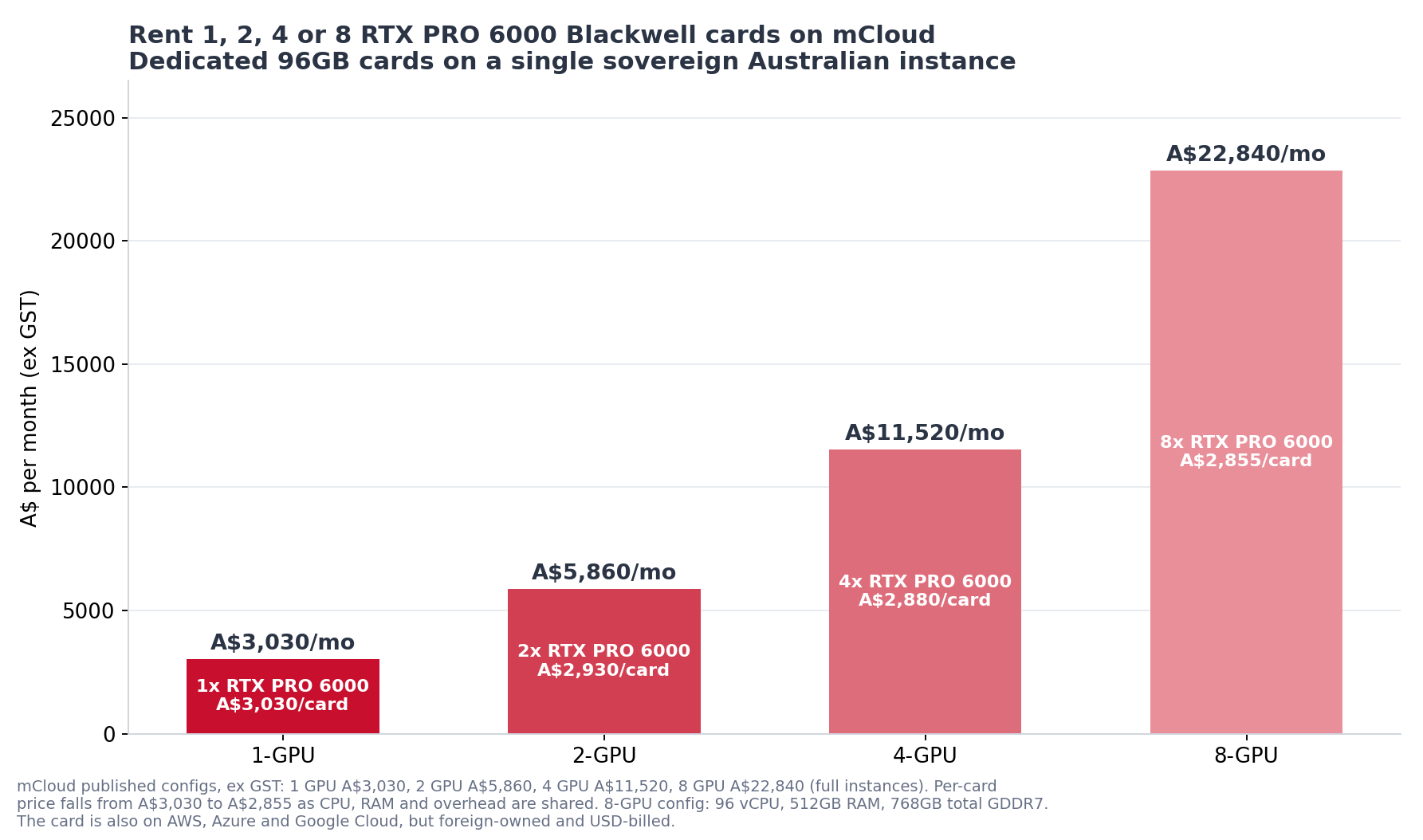
The per-card price falls modestly from A$3,030 to A$2,855 as CPU, RAM and overhead are shared. Because the card is PCIe-only, an eight-card instance is eight independent 96GB devices (768GB of GDDR7 in total) rather than one pooled memory space, which suits parallel inference, rendering farms, or multi-tenant virtual workstations more than a single giant training job.
What the A$3,030 actually includes
Every provider in the table above quotes a bare GPU rate. The mCloud price is a complete instance, which is part of why the like-for-like GPU comparison understates what you get.
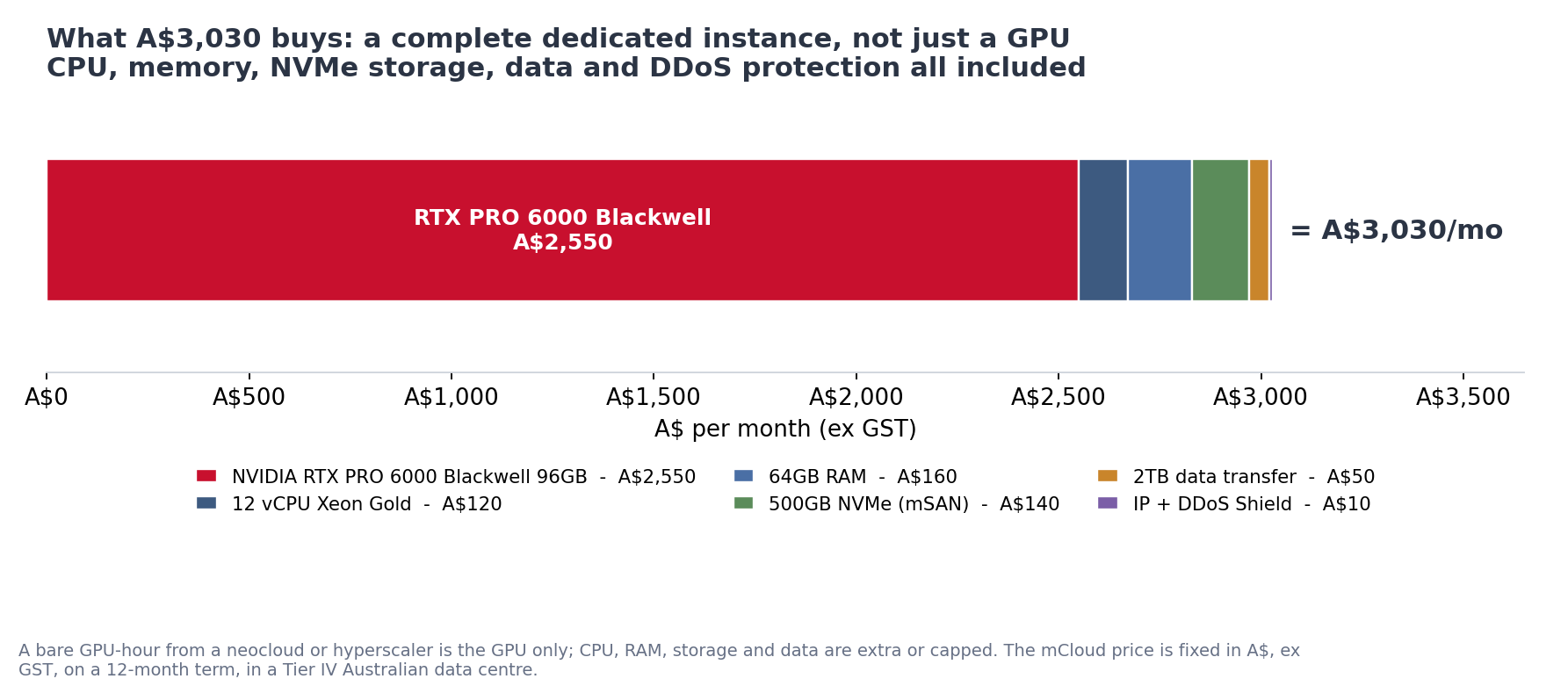
The GPU is A$2,550 of the A$3,030; the rest is 12 vCPU of Xeon Gold, 64GB of RAM, 500GB of NVMe, 2TB of data transfer, an IP and DDoS protection, all included and fixed in Australian dollars. On a hyperscaler or neocloud those supporting resources are separate line items or capped, and the bill is in US dollars. So the real all-in gap to the cheaper providers is smaller than the GPU-line difference suggests, and against AWS the all-in gap runs the other way, in mCloud's favour.
RTX PRO 6000 Blackwell vs H100 and H200: which GPU for AI?
The RTX PRO 6000 has more memory than an H100 (96GB versus 80GB) and sits close to an H200 on VRAM, which makes it tempting for AI work. The deciding factor is not memory but interconnect and scale. The RTX PRO 6000 is PCIe-only with no NVLink, so it is at its best on single-GPU and lightly-parallel jobs: large-model inference, fine-tuning, and rendering that fit on one big card. The H100 and H200 use NVLink and HBM memory, which makes them far stronger for training large models spread across many interconnected GPUs.
The simple rule: choose the RTX PRO 6000 Blackwell for memory-heavy single-GPU inference, fine-tuning and professional visualisation; choose an NVIDIA H200 when you need to train large models across multiple GPUs that must talk to each other at speed. mCloud offers the RTX PRO 6000, H200, H100 and A100 on the same sovereign platform, so you can match the card to the workload rather than the other way around.
How many RTX PRO 6000 GPUs do you need?
Because the card is PCIe-only, adding GPUs adds independent 96GB devices rather than one pooled memory space, so sizing is about how many parallel jobs you run, not one giant model. As a guide:
- One card (96GB): most inference and fine-tuning up to 70B-class models in quantised form, single-user professional rendering, or one to a few virtual workstations.
- Two to four cards (192-384GB): rendering farms, multi-user VDI, running several models in parallel, or serving higher inference throughput.
- Eight cards (768GB total): high-density inference serving, a shared virtual-workstation platform, or a studio render node.
If your workload is a single very large model trained across GPUs, the lack of NVLink makes the RTX PRO 6000 the wrong tool, and NVLinked data-centre cards such as the H200 will perform far better. For everything memory-heavy but single-GPU, the RTX PRO 6000 is ideal, and mCloud lets you start with one and grow to eight on the same instance.
Sovereignty and certification
This is where an Australian buyer's decision is usually made. The mCloud RTX PRO 6000 runs in Micron21's own Tier IV certified data centre in Melbourne, on our own network (AS38880), behind our own DDoS mitigation, operated by Australian staff, in a 100 percent Australian-owned business. For government, defence and regulated workloads, the certification stack is the shortlist:
| Requirement | Micron21 status |
|---|---|
| Facility | Australia's first Uptime Institute Tier IV certified data centre (Melbourne) |
| Physical security | Zone 4 PSPF facility |
| Government hosting | Certified provider under the Hosting Certification Framework (HCF) |
| Security assessment | IRAP assessed to PROTECTED |
| Defence industry | DISP (Defence Industry Security Program) member |
| Standards | ISO 27001, 27002, 27018, 14520; PCI compliant |
| Ownership | 100% Australian owned and operated; no foreign parent |
To our knowledge Micron21 is the only Australian-owned provider publishing a self-serve RTX PRO 6000 price. The hyperscalers offer the card but are foreign owned; the other Australian sovereign operators (Sharon AI, Firmus, ResetData, Vault Cloud, Scaile, Macquarie Cloud Services) require a quote. So for a buyer who needs this card, in Australia, from an Australian operator, at a price they can see, mCloud is again the transparent choice, this time at a price that also happens to be competitive.
Which provider actually fits your workload
If your only criterion is the lowest GPU rate and the data can live anywhere, the offshore neoclouds are cheaper than mCloud: Vast.ai, Nebius, Hyperstack, RunPod and Sesterce all sit below us; use them, they are legitimate. If you are already deep in a hyperscaler ecosystem and want the card next to your other services, the g7e, g4 and NC RTX6k v6 instances exist, but you will pay a clear premium over mCloud to get it, on AWS and Google Cloud alike.
The mCloud RTX PRO 6000 is the right answer when the requirement reads like this: one or more dedicated 96GB Blackwell cards, running production inference, fine-tuning, visualisation or virtual workstations, with data and users in Australia under an Australian-owned operator, on guaranteed dedicated hardware, billed in fixed Australian dollars, with government-grade certification and local engineers, at a mid-market price that beats AWS. For that buyer, mCloud is not a compromise on price and it is the only sovereign, transparent option; it is a genuinely strong all-round choice.
Frequently asked questions
How much does an NVIDIA RTX PRO 6000 Blackwell cost per month in Australia?
A$3,030 ex GST on Micron21 mCloud for a complete single-GPU instance (12 vCPU, 64GB RAM, 500GB NVMe, 2TB data, DDoS). It scales to A$5,860 (2 GPU), A$11,520 (4 GPU) and A$22,840 (8 GPU), which is A$2,855 per card at eight. The GPU rate is about US$2.49/hr, cheaper than both AWS (~US$3.36/hr) and Google Cloud (~US$4.50/hr).
Do AWS, Azure and Google Cloud offer the RTX PRO 6000 Blackwell?
Yes. AWS (g7e) and Google Cloud (g4) both offer it directly, and Azure lists it in public preview. There is no 8-GPU minimum on this card. On verified pricing both AWS (~US$3.36/hr) and Google Cloud (~US$4.50/hr) cost more than mCloud.
Is mCloud competitive on the RTX PRO 6000?
Yes. mCloud's GPU rate (~US$2.49/hr) is mid-market and cheaper than both hyperscalers publishing this card, about 26 percent below AWS and 45 percent below Google Cloud. It is dearer only than the budget offshore neoclouds, and adds a full instance plus Australian sovereignty.
What is the RTX PRO 6000 Blackwell good for?
Large-VRAM single-GPU work: local AI inference and fine-tuning (30B-class FP16, 70B-class quantised), professional visualisation, rendering, media and VFX, and virtual workstations. PCIe-only with no NVLink, so it favours single-GPU workloads over large distributed training, where an H200 fits better.
Which Australian providers publish an RTX PRO 6000 price?
To the best of our research in July 2026, Micron21 is the only Australian-owned provider publishing a self-serve price. The hyperscalers offer the card but are foreign owned; other sovereign operators require a quote.
Does the A$3,030 include GST and data transfer?
The price is ex GST and includes 2TB of monthly data transfer, with more at A$50 per 2TB block. Billed in Australian dollars with no exchange exposure.
What is the difference between the RTX PRO 6000 and the RTX A6000?
They are three generations apart. The RTX PRO 6000 Blackwell (2025) has 96GB of GDDR7, Blackwell architecture, FP4 support and 1,792 GB/s bandwidth. The RTX A6000 (2020) is an Ampere card with 48GB of GDDR6 and 768 GB/s. Despite the similar name they are very different in capability and cost; mCloud runs the Blackwell RTX PRO 6000.
Does the RTX PRO 6000 Blackwell support NVLink?
No. It is PCIe Gen 5 only, with no NVLink. Multi-GPU instances are independent 96GB cards rather than a pooled memory space, so it suits single-GPU and parallel workloads rather than large distributed training.
Can I run Llama 70B on an RTX PRO 6000?
Yes. The 96GB of VRAM comfortably holds a 70B-class model in 4-bit or 8-bit quantised form on a single card, with room for context, and a 30B-class model in FP16.
Pricing sources and verification
Competitor figures were checked in the first week of July 2026 against providers' own pricing pages and the GetDeploying RTX PRO 6000 index. Prices change frequently; treat these as a dated snapshot and confirm at the source. Exchange rate: 1 USD = 1.42 AUD, the H1 2026 average.
| Provider | Website | Pricing source |
|---|---|---|
| Micron21 mCloud | micron21.com | mCloud RTX PRO 6000 product page and calculator |
| AWS (g7e) | aws.amazon.com | EC2 instance types (g7e) |
| Microsoft Azure (NC RTX6k v6) | azure.microsoft.com | Azure GPU VM sizes |
| Google Cloud (g4) | cloud.google.com | Google Cloud pricing calculator |
| RunPod, Nebius, Hyperstack, Sesterce, Koyeb, Nova Cloud, Packet.ai, Akamai, CoreWeave | various | Aggregated via GetDeploying RTX PRO 6000 index (July 2026) |
Card specifications from the NVIDIA RTX PRO 6000 Blackwell page. Australian sovereign providers surveyed with no published price: Sharon AI, Firmus, ResetData, Vault Cloud, Scaile, Macquarie Cloud Services.
The bottom line
The RTX PRO 6000 Blackwell is a current-generation, widely-available 96GB card, so this is a straight comparison with no structural tricks: the hyperscalers offer it, the neoclouds offer it, and mCloud offers it. On price, mCloud is mid-market and cheaper than both AWS and Google Cloud, dearer only than the budget offshore neoclouds. On everything else, a complete instance, dedicated hardware, Australian dollars, and genuine sovereignty from a Tier IV, IRAP-assessed, Australian-owned operator, mCloud is the strongest choice an Australian buyer can make. Not the cheapest hour on Earth, but a fair one, and the only one that keeps your workload sovereign without sending you to a sales queue.
See the real price for your configuration. Build your RTX PRO 6000 instance, from one card to eight, on the mCloud calculator: mCloud Pricing Calculator
