
mCloud GPU vs AWS GPU: A Sovereign Australian Alternative for AI Workloads
03 Jul 2026, by James Braunegg, CEO and Founder, Micron21
When an Australian business decides to run AI or GPU accelerated workloads in the cloud, AWS is usually the first name on the list. It is enormous, capable, and familiar. But familiar is not the same as best, and for a growing number of Australian organisations the real question is not "how do we use AWS for GPU", it is "should we, and what are the alternatives". This article compares the Micron21 mCloud GPU platform directly against AWS GPU instances, with a specific head to head on the NVIDIA A100, so the trade offs are clear rather than assumed.
The same underlying NVIDIA silicon is available from both. What differs is everything around it: where your data lives, who owns the infrastructure, how you are billed, what it costs to get your data back out, and who answers when something breaks. Those differences are where the real decision is made.
The same GPUs, two very different models
Both AWS and mCloud give you access to data centre class NVIDIA GPUs, including the NVIDIA A100, the workhorse of serious AI training and inference. On AWS, NVIDIA A100 capacity is delivered through the P4 family, principally the p4d.24xlarge instance, which packs eight NVIDIA A100 40GB GPUs alongside 96 vCPUs and 1152 GiB of memory. On mCloud, the same NVIDIA A100 is available in both its 40GB and 80GB forms, and crucially you can take a single GPU rather than being pushed into a large multi GPU instance.
That first structural difference matters more than it looks. On AWS, the on demand NVIDIA A100 offering is built around the eight GPU p4d instance, which at the time of writing lists at roughly 32 US dollars per hour. If your workload genuinely needs eight A100s, that is fine. If it needs one or two, you are still renting the architecture around eight, or hunting for scarce smaller alternatives. mCloud lets you start with exactly one NVIDIA A100, scale to as many as you need, and mix in smaller A10 cards or larger H100 and H200 cards for different jobs. The granularity is the point: you pay for the capacity the workload actually requires.
Cost is more than the sticker price
Comparing GPU clouds on the headline hourly rate is the most common mistake organisations make, because the hourly rate is only part of the bill. The three costs that quietly reshape a hyperscaler invoice are data egress, currency, and the supporting services around the GPU.
Data egress is the big one for AI workloads. AWS, like the other large hyperscalers, charges to move data out to the internet, currently around US$0.09 per gigabyte after a small free allowance. That sounds trivial until you remember what AI workloads actually do. Moving a single terabyte of model weights or training data out can cost in the order of US$80 to US$120, and industry analysis consistently finds that egress, storage and networking fees add 20 to 40 percent on top of the raw compute bill. If your pipeline regularly pulls models or datasets out of the cloud, that recurring tax can rival the GPU cost itself.
mCloud takes a fundamentally simpler approach. Every mCloud instance includes 2TB of data transfer, counted across both inbound and outbound traffic, and if you need more you buy it in 2TB blocks at A$50 each. That works out to about 2.5c per gigabyte in Australian dollars for anything beyond the included allowance, roughly a quarter of the AWS rate, before you even account for the currency difference. For most workloads the included 2TB means data transfer costs nothing extra at all, and when it does the price is predictable and modest rather than a metered surprise at the end of the month. That difference in egress model changes the total cost of ownership entirely, which is why we encourage customers to compare the all in figure rather than the hourly rate.
Currency is the second hidden cost. AWS GPU pricing is set in US dollars, so an Australian business carries exchange rate risk on every invoice, and a weakening Australian dollar quietly inflates the bill regardless of usage. mCloud is billed in Australian dollars, so the price you budget is the price you pay.
The third factor is everything bundled around the GPU. Storage tiers, load balancers, network gateways, support plans and data processing charges all appear as separate line items on a hyperscaler bill, and the final figure is often well above the compute estimate that justified the project. Because the most honest comparison is a complete one, the mCloud pricing calculator lets you build the exact GPU configuration you need and see the real Australian dollar price, which you can then compare against an equivalent AWS build including its egress and ancillary charges.
mCloud NVIDIA A100 vs AWS NVIDIA A100, head to head
To compare like for like, each card is on its own row, so the 40GB and 80GB options sit side by side for both providers.
| Option | Memory | Smallest unit | Price (per GPU/hr, 1-yr no upfront) | Billing | Data transfer |
|---|---|---|---|---|---|
| mCloud NVIDIA A100 40GB | 40GB HBM2e | 1 GPU | A$2.24 (~US$1.57) | A$ | 2TB incl, then A$50/2TB |
| mCloud NVIDIA A100 80GB | 80GB HBM2e | 1 GPU | A$4.49 (~US$3.16) | A$ | 2TB incl, then A$50/2TB |
| AWS NVIDIA A100 40GB (p4d) | 40GB HBM2 | 8-GPU instance | ~US$2.00 | US$ | ~US$0.09/GB egress |
| AWS NVIDIA A100 80GB (p4de) | 80GB HBM2e | 8-GPU instance | ~US$2.50 | US$ | ~US$0.09/GB egress |
mCloud is billed month to month on a 12-month contract with no upfront payment, so AWS is shown at its 1-year no upfront Savings Plan rate (about 27% off on-demand), not the cheaper all-upfront rate, for a like-for-like comparison. mCloud price is the full instance including 2TB data; the AWS rate is compute only.
On raw access to the chip the two are equivalent: an NVIDIA A100 is an NVIDIA A100, with the same memory and bandwidth whether it is racked in an AWS region or in our Tier IV facility in Melbourne. The differences are flexibility, where mCloud lets you provision a single NVIDIA A100 rather than an eight GPU instance, data location, where mCloud keeps the workload and its data in Australia, ownership, where Micron21 owns the whole stack end to end with local engineers on SLA care plans, and form factor, where mCloud also offers bare metal, bring your own hardware and full virtual data centres rather than instances alone.
Can you even run an NVIDIA A100 in Australia?
Before comparing price there is a more basic question that is easy to overlook: can each provider actually give you an NVIDIA A100 inside Australia at all? For a sovereign workload that matters more than the hourly rate, and the answer is not the same for every provider.
| Provider | NVIDIA A100 40GB in Australia | NVIDIA A100 80GB in Australia |
|---|---|---|
| mCloud | Yes, Tier IV Melbourne | Yes, Tier IV Melbourne |
| AWS | Yes, Sydney (p4d) | No, US and Israel only (p4de) |
| Azure | Via NC A100 v4 (80GB card) | Yes, Australia East (NC A100 v4) |
| Google Cloud | No, offshore only (Singapore/US) | No, offshore only (Singapore/US) |
Micron21 runs both the NVIDIA A100 40GB and the NVIDIA A100 80GB in our own Tier IV data centre in Melbourne, so the GPU, the data and the workload all stay in Australia. On AWS the NVIDIA A100 40GB (p4d) is available in Sydney, but the NVIDIA A100 80GB (p4de) is not offered anywhere in Australia, only in the United States and Israel, so an 80GB workload must send its data and models to a US region. On Google Cloud the A2 family that carries the NVIDIA A100, in both 40GB and 80GB forms, is not available in any Australian region at all; the NVIDIA A100 is only reachable in Singapore or the United States. Azure is the exception: its NC A100 v4 (the 80GB card) is available in Australia East, so Azure can genuinely run an NVIDIA A100 80GB onshore, on a foreign owned platform.
There are two consequences. First, for any provider that cannot offer the card locally, the sovereignty question is answered before price is even discussed: the workload leaves the country. Second, the prices below are United States region prices, the cheapest each hyperscaler charges; where the same GPU is available in an Australian region it typically costs 20 to 30 percent more, so the real local comparison is more favourable to mCloud than the figures show.
You also cannot always buy just one: the 8-GPU minimum
There is a second trap that the per-hour rate hides, and it is arguably bigger than the regional one. Not every provider lets you rent a single NVIDIA A100. On AWS the A100 is sold only inside the eight-GPU p4d and p4de instances, so even if your workload needs exactly one card, the smallest amount you can buy is eight. mCloud, Azure and Google Cloud all let you provision a single A100; AWS does not, and that turns its true minimum bill into something very different from the per-GPU figure.
In monthly terms, the cheapest way to touch a single NVIDIA A100 on AWS is to rent the whole eight-GPU instance: roughly US$14,976 a month for the 40GB p4d in Sydney, or about US$14,400 a month for the 80GB p4de offshore in the US, both on a one-year no-upfront commitment. On mCloud a single 40GB card is about US$1,137 a month and a single 80GB card about US$2,271. For a team that needs one or two cards, AWS's eight-GPU minimum makes the real entry cost roughly ten times higher than mCloud, purely because you are forced to pay for capacity you will never use.
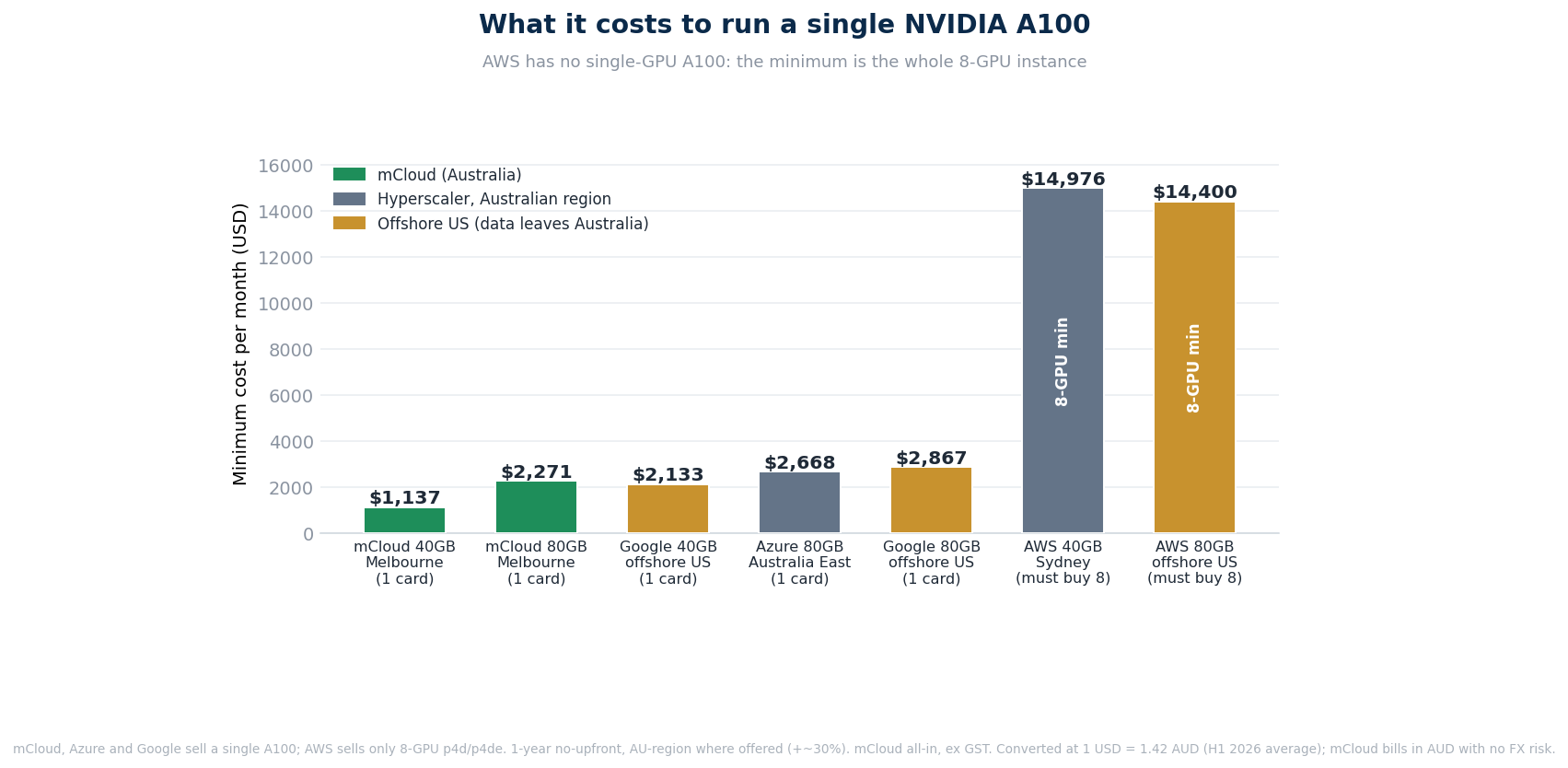
This also means the earlier per-GPU comparison, where AWS's eight-GPU price is divided by eight, is generous to AWS, because in practice you cannot buy that one-eighth. The only genuinely fair way to compare AWS on price is at the quantity it forces you to buy: eight.
And when you compare eight cards to eight cards, mCloud stays ahead for a second reason: mCloud's price per card falls as you scale, whereas dividing a fixed AWS instance does not. A single mCloud 40GB card is A$1,618 a month, but eight 40GB cards are A$11,544 a month, which is A$1,443 per card and includes 86 CPU cores and 512GB of memory. The 80GB scales the same way, from A$3,230 for a single card to A$24,440 for eight, about A$3,055 per card. So comparing a single mCloud card against one-eighth of an AWS instance understates mCloud twice over: it ignores both the eight-GPU minimum you must actually pay on AWS and the volume discount mCloud gives as you grow.
| mCloud (ex GST) | 1 card / month | 8 cards / month | Per card at 8 |
|---|---|---|---|
| NVIDIA A100 40GB | A$1,618 | A$11,544 | A$1,443 (incl 86 vCPU, 512GB) |
| NVIDIA A100 80GB | A$3,230 | A$24,440 | A$3,055 |
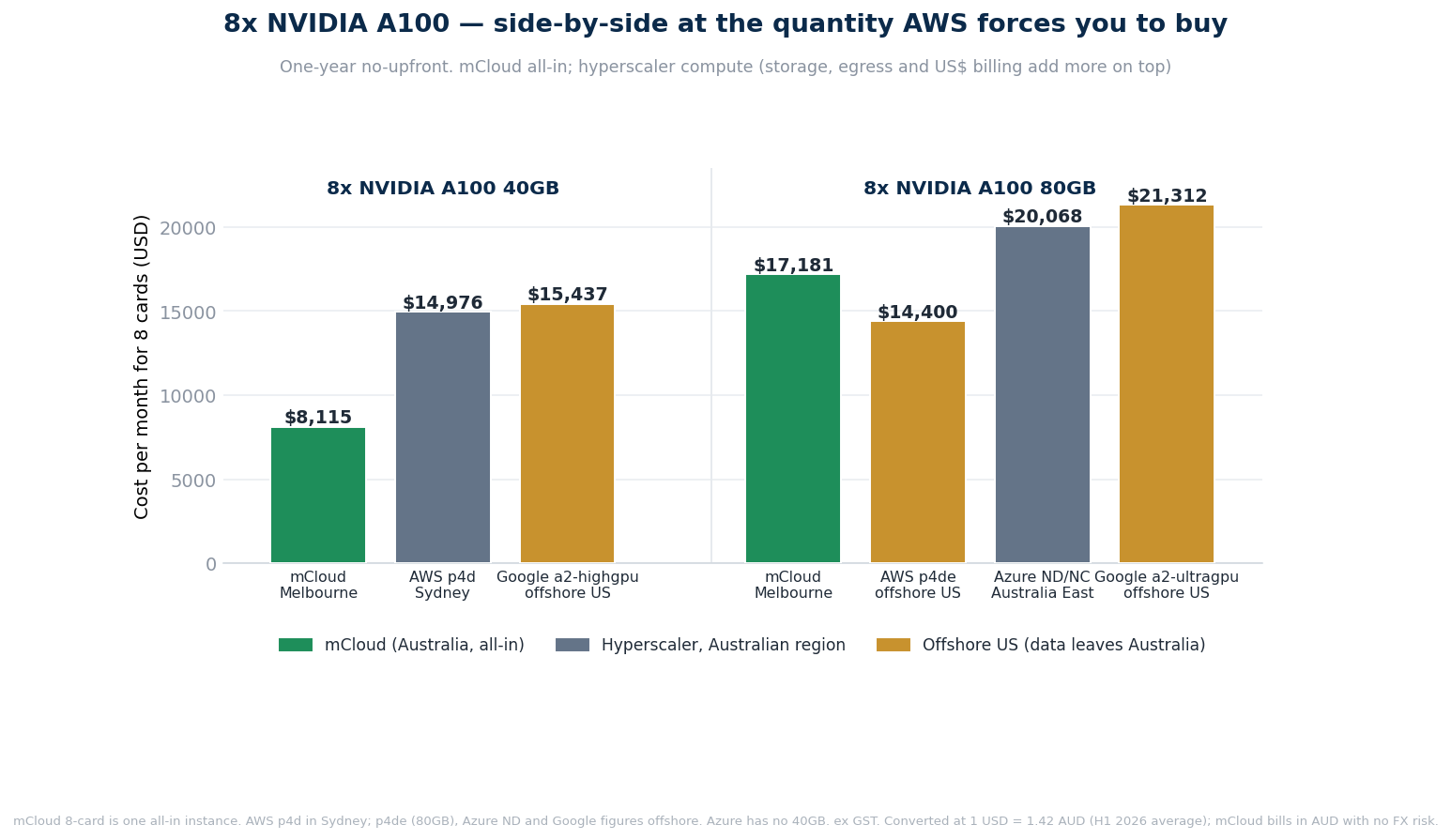
At eight 40GB cards, mCloud is about US$8,115 a month all-in, against roughly US$14,976 for the AWS p4d in Sydney and US$15,437 for Google offshore in the US, with Azure offering no 40GB card. At eight 80GB cards, mCloud is about US$17,181 all-in, against US$20,068 for Azure in Australia East and US$21,312 for Google offshore. The only figure under mCloud at this size is the offshore AWS p4de at about US$14,400, and only by running in the US; brought onshore at the usual regional premium it would be around US$18,720, above mCloud.
| 8x NVIDIA A100, per month | 40GB | 80GB |
|---|---|---|
| mCloud (Melbourne, all-in) | ~US$8,115 (A$11,544) | ~US$17,181 (A$24,440) |
| AWS (Sydney 40GB; 80GB offshore US) | ~US$14,976 | ~US$14,400 offshore |
| Azure (Australia East, 80GB only) | not offered | ~US$20,068 |
| Google Cloud (offshore US) | ~US$15,437 | ~US$21,312 |
The mCloud figures are complete instances including CPU, memory, storage and data; the hyperscaler figures are compute only, with storage, egress and US dollar billing still to add, so the real gap is wider than the table shows. For a buyer who needs Australian capacity, mCloud is both available and, at the quantity AWS forces you to buy, the cheapest onshore option on both cards.
What the NVIDIA A100 actually costs on mCloud, and how it compares
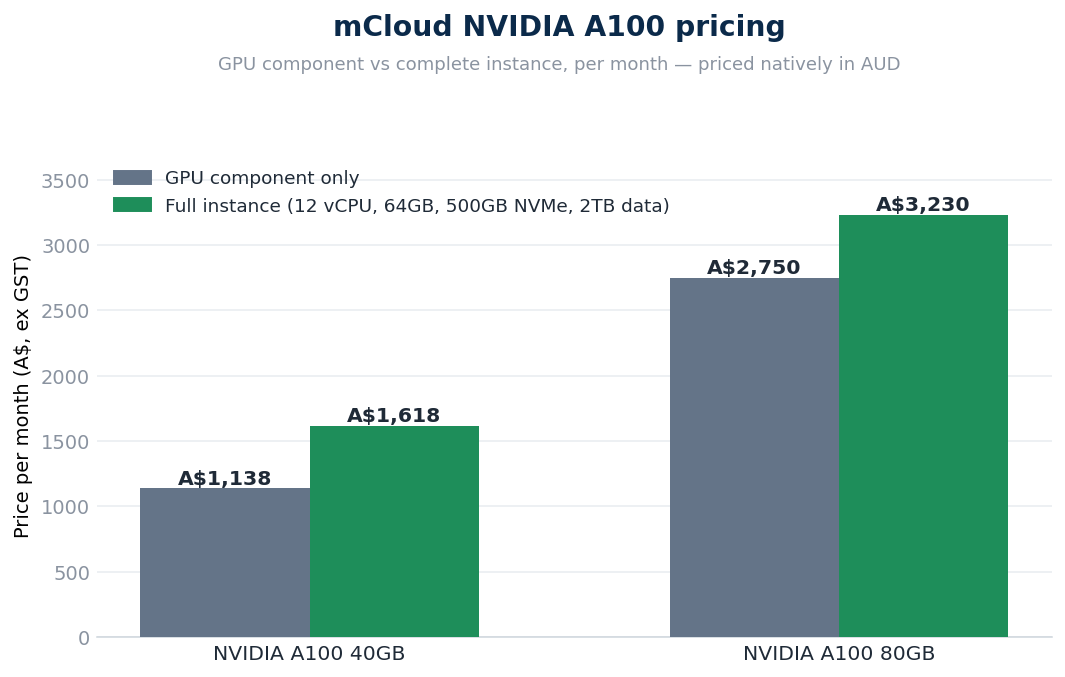
Because the most common question is simply what it costs, here are the real mCloud NVIDIA A100 prices, ex GST, in Australian dollars, based on a 720 hour month. The 40GB instance is configured with 12 CPU cores, 64GB of memory, 500GB of NVMe storage and the included 2TB of data.
| mCloud NVIDIA A100 (ex GST) | Per month (A$) | Per hour (A$) | Per hour (US$ approx) |
|---|---|---|---|
| NVIDIA A100 40GB, full instance | $1,618 | $2.24 | ~$1.57 |
| NVIDIA A100 40GB, GPU component only | $1,138 | $1.58 | ~$1.11 |
| NVIDIA A100 80GB, full instance | $3,230 | $4.49 | ~$3.16 |
| NVIDIA A100 80GB, GPU component only | $2,750 | $3.81 | ~$2.68 |
A headline GPU rate is misleading on its own, so the fair way to compare is the total monthly cost of an identical build, on the same continent, on each platform. Three things make that fair. First, mCloud is billed month to month on a twelve month contract with no upfront payment, so the hyperscalers are shown at their one year no upfront committed rate, billed monthly, not on demand or the cheaper all upfront commitment. AWS publishes about 27 percent off on a one year no upfront Savings Plan; Google Cloud and Azure committed rates, also billed monthly, are shown at a comparable indicative 27 percent. Second, the build is matched: a single NVIDIA A100, around 12 CPU cores and 64GB of memory, 500GB of fast SSD, and 1TB of data in plus 1TB out per month, with storage and data already in the mCloud price and added on top of committed compute for the hyperscalers. Third, and decisive for a sovereign comparison, the hyperscalers are priced in their Australian region wherever the NVIDIA A100 is actually offered there, which adds roughly 30 percent to the US compute rate; where the card is not available in Australia at all, the figure shown is the offshore US price, labelled as such, because using it means your data leaves the country.
NVIDIA A100 40GB: total monthly cost, Australian region (1-year no upfront)
| Provider | Compute | + 500GB SSD | + 1TB egress | Total / month |
|---|---|---|---|---|
| mCloud, Melbourne (AU) | Full instance incl 500GB NVMe + 2TB data | ~US$1,137 | ||
| AWS p4d, Sydney (AU) | ~$1,872 | ~$40 | ~$90 | ~US$2,002 |
| Google Cloud a2-highgpu (offshore US, no AU) | ~$1,930 | ~$85 | ~$118 | ~US$2,130 |
| Azure | No 40GB NVIDIA A100 offered | n/a | ||
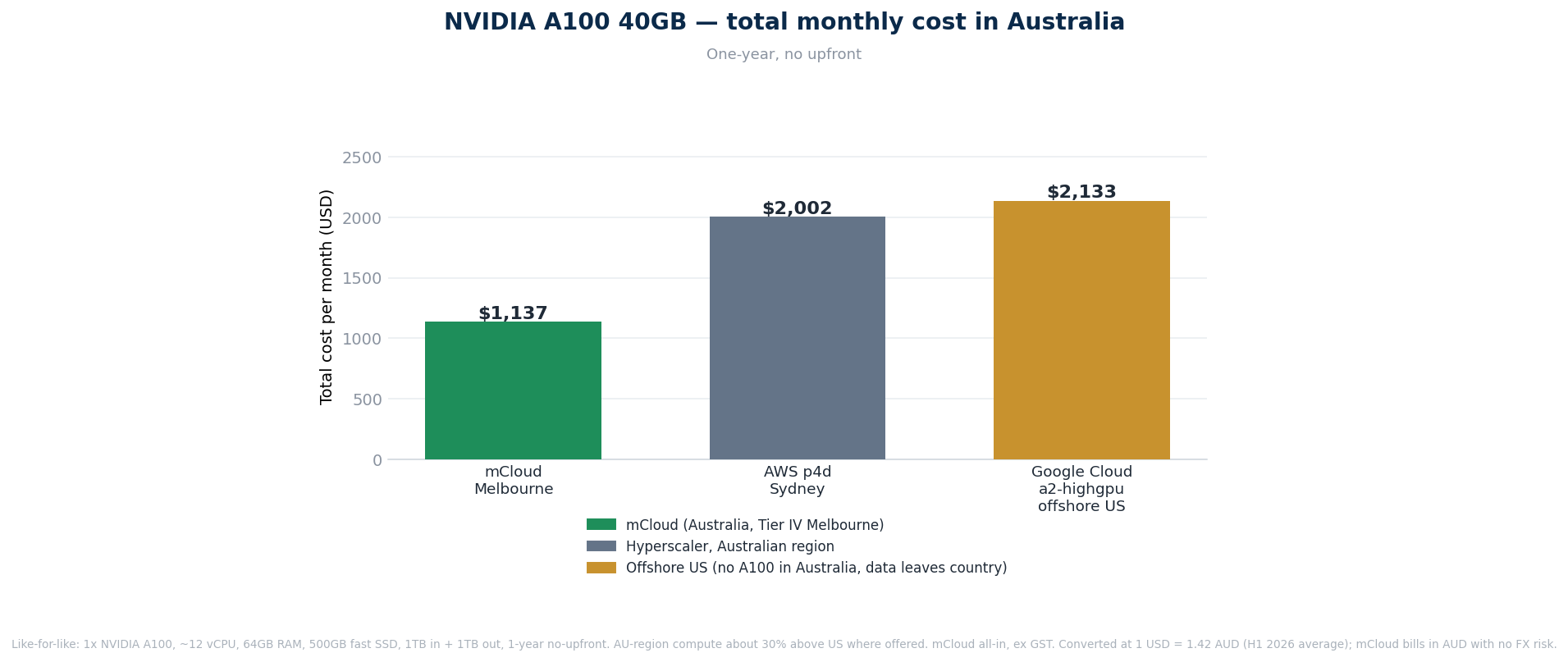
On the 40GB card mCloud wins comfortably on home soil, at about US$1,137 per month in Melbourne against roughly US$2,002 for AWS p4d in Sydney. Google Cloud has no NVIDIA A100 in any Australian region, so its only option is offshore in the United States at about US$2,130, with the data leaving Australia. mCloud is roughly 40 percent cheaper than the only hyperscaler that can run a 40GB NVIDIA A100 in Australia at all.
NVIDIA A100 80GB: total monthly cost, Australian region (1-year no upfront)
| Provider / region | Compute | + 500GB SSD | + 1TB egress | Total / month |
|---|---|---|---|---|
| mCloud, Melbourne (AU) | Full instance incl 500GB NVMe + 2TB data | ~US$2,271 | ||
| Azure NC A100 v4, Australia East (AU) | ~$2,509 | ~$73 | ~$87 | ~US$2,668 |
| AWS p4de (offshore US, no AU) | ~$1,800 | ~$40 | ~$90 | ~US$1,930 |
| Google Cloud a2-ultragpu (offshore US, no AU) | ~$2,664 | ~$85 | ~$118 | ~US$2,870 |
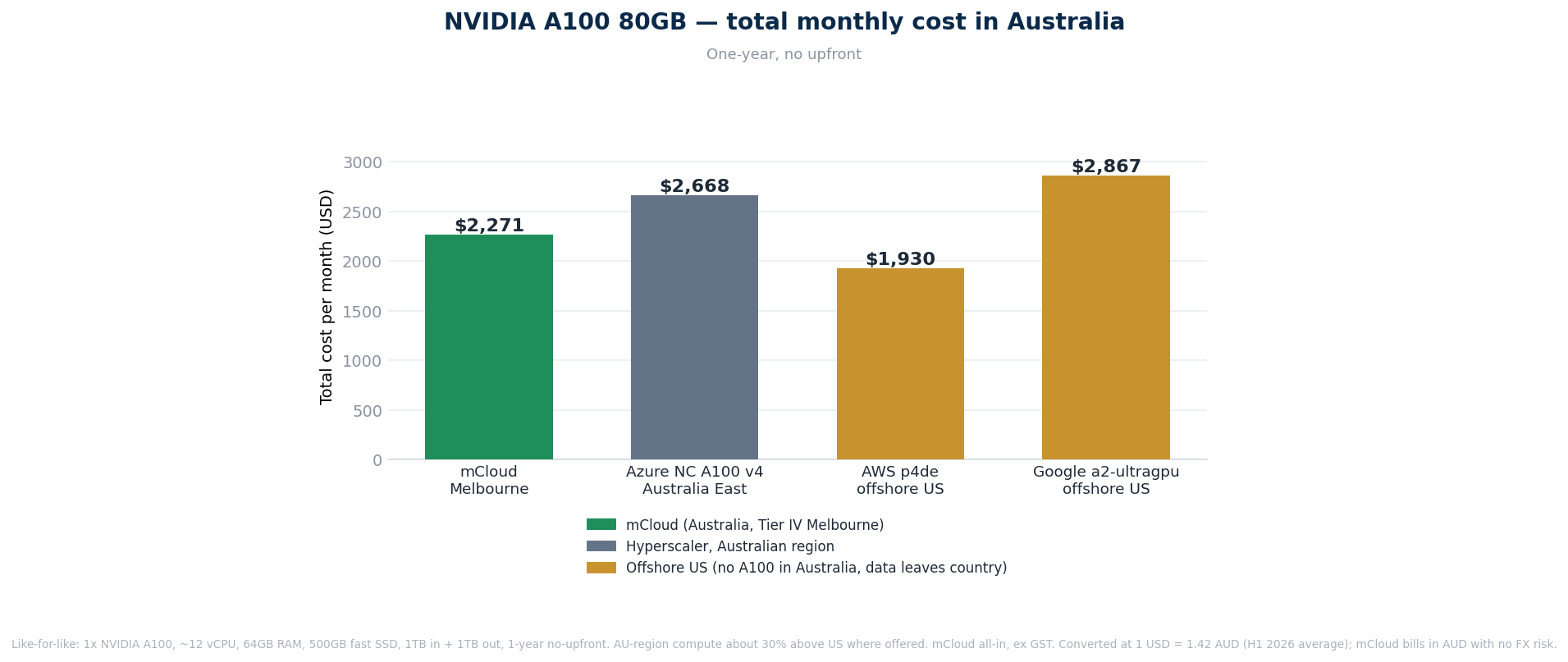
The 80GB card is the more revealing case, because local availability is scarce. Azure is the only hyperscaler offering an 80GB NVIDIA A100 in an Australian region, and in Australia East the matched build comes to about US$2,668 per month against US$2,271 on mCloud, so onshore and like for like mCloud is about 15 percent cheaper than the only other provider that can keep an 80GB workload in Australia. AWS and Google Cloud cannot run an 80GB NVIDIA A100 in Australia at all; their figures, about US$1,930 on AWS and US$2,870 on Google Cloud, are offshore United States prices that move your data out of the country. AWS run offshore is the one number that undercuts mCloud, and only by leaving Australia.
Even that offshore advantage erodes with data. Because every mCloud instance includes 2TB of transfer and extra data is only A$50 per 2TB block, the mCloud total barely moves as data grows, while the offshore hyperscaler bill climbs at roughly US$0.09 per gigabyte of egress on top of compute. mCloud is already cheaper than Azure in Australia from the first terabyte, and it overtakes even the cheapest offshore option, AWS in the United States, at around 5TB of outbound data per month, before US dollar exchange risk and Australian data residency are even counted.

A few caveats keep the comparison honest. The hyperscaler rates are one year no upfront committed pricing billed monthly, matched to mCloud's month to month twelve month contract rather than to the cheaper all upfront commitment or to on demand. AWS uses its published one year no upfront Savings Plan, about 27 percent off on demand; the Google Cloud and Azure one year figures are indicative at a comparable 27 percent and exact committed GPU rates often require a sales quote. Australian region pricing is taken as roughly 30 percent above the United States compute rate, applied only where the card is actually available locally; offshore figures are United States prices. AWS rates are derived per GPU from eight GPU instances that bundle more CPU and memory than a single mCloud instance, storage and egress prices vary by region, and the mCloud price already includes the full instance, 500GB of NVMe and 2TB of data. The honest summary: compared like for like inside Australia, mCloud is cheaper than every hyperscaler that can actually run an NVIDIA A100 here, on both the 40GB and 80GB cards; the only way to beat mCloud on price is to run offshore on AWS and accept that your data leaves the country, and even that disappears once a workload moves real volumes of data. The way to settle it for your own configuration is to build it on the mCloud calculator and compare the all in figure against an equivalent committed hyperscaler quote.
Sovereignty: the difference that does not fit in a table
The single biggest reason Australian organisations move GPU workloads off the hyperscalers is sovereignty. With AWS, your data sits within the AWS global platform and, depending on region and service, may be subject to foreign jurisdiction. For AI workloads this is rarely trivial, because the data involved, patient records, legal documents, financial data, government information, proprietary models, is usually exactly the kind of data that should not leave the country or sit under another nation's laws.
mCloud is a sovereign Australian platform. The GPUs sit in our own Tier IV certified data centre in Melbourne, connected to our own global network, AS38880, protected by our own DDoS mitigation, and operated by our own Australian staff. There is no offshore dependency and no foreign parent company in the chain of custody. For healthcare, legal, financial and government workloads, that is frequently the deciding factor, and it is something a hyperscaler region inside Australia still cannot fully replicate because the platform itself is foreign owned and operated.
Ownership, support and accountability
AWS is a remarkable platform, but when something goes wrong you are one of millions of accounts, and support is itself a paid tier. The infrastructure is abstracted away from you by design, which is convenient until you need someone who understands your specific environment.
Because Micron21 owns and operates every layer, the data centre, the AS38880 network, the DDoS protection, the SOC and NOC, and the mCloud platform itself, there is no third party to point at when an issue spans layers. Our Australian engineers are located on site with the infrastructure, and our customer care plans provide defined response times backed by a published service level agreement, including proactive monitoring on the higher tiers. For many businesses, knowing that a local engineer who understands their setup will answer is worth as much as any line on a price list.
Flexibility beyond a single instance
A further difference is how far the platform bends to your needs. AWS gives you instances. mCloud gives you instances, but also dedicated bare metal GPU servers when you want full hardware isolation, the ability to bring your own hardware into the platform, and full virtual data centres where you take a pool of resources and carve it up yourself. You also get complete API access and a self service portal to resize, snapshot, network, firewall and load balance in seconds. As an AI project matures from experiment to production, that ability to move between shared cloud GPUs, dedicated nodes and bare metal without leaving the platform avoids the painful re architecture that often comes with scaling on a hyperscaler.
Where each platform makes sense
None of this means AWS is the wrong choice for everyone. If your entire stack already lives in AWS, if you depend on specific AWS managed services that sit alongside the GPU, or if you need to burst to thousands of GPUs in a region on a particular afternoon, the hyperscaler model has real strengths and the integration benefits can outweigh the costs.
mCloud GPU is the stronger choice when sovereignty matters, when your data and users are in Australia, when you want predictable Australian dollar billing without egress surprises, when you need the flexibility of a single NVIDIA A100 rather than an eight GPU minimum, when you want dedicated or bare metal options, and when you value local engineers who own the whole stack. For a large and growing share of Australian AI workloads, particularly in regulated industries, that describes the requirement exactly.
The most useful way to settle the question for your own workload is to model it properly. Build your ideal NVIDIA A100 configuration on the mCloud pricing calculator, then compare the all in Australian dollar figure, including data transfer, against the equivalent AWS build with its egress and ancillary charges. More often than not, once the full picture is on the table, the sovereign option is also the more economical one.
Pricing sources and verification
So that anyone can validate the figures rather than take them on trust, the competitor pricing used here was checked in June 2026 and comes from the providers' own pricing pages and independent pricing trackers. Prices change frequently, so treat these as a point in time reference and confirm the current rate for your region at the source before relying on it.
Exchange rate: every US dollar figure is converted at 1 USD = 1.42 AUD, the average rate for the first half of 2026 (it ranged from about 1.38 to 1.49 over that period). We use the period average rather than a single day's rate because it is the most representative and the least open to cherry-picking. Crucially, this currency risk applies only to the hyperscalers: their pricing is set in US dollars, so an Australian buyer's bill rises whenever the Australian dollar weakens, whereas mCloud is priced and billed in Australian dollars and carries no exchange-rate risk at all.
- AWS NVIDIA A100 p4d (40GB) and p4de (80GB): EC2 on-demand pricing, Savings Plans, p4d.24xlarge, p4de.24xlarge. Regional availability: AWS regional services list.
- Google Cloud NVIDIA A100 a2-highgpu (40GB) and a2-ultragpu (80GB): GPU pricing, a2-highgpu-1g. Region availability: GPU regions and zones.
- Azure NVIDIA A100 NC A100 v4 (80GB): VM pricing, NC24ads A100 v4. Region availability: products by region.
- Data egress: AWS data transfer pricing, with comparable per-gigabyte egress on Google Cloud and Azure.
At the time of this review the published rate for each region and service was the figure used above. Drop the captured source-page screenshots into the boxes below so a reader can see exactly what was charged at the date checked.
The bottom line
mCloud GPU and AWS GPU run the same NVIDIA hardware, including the NVIDIA A100, so the decision is not really about the chip. It is about where your data lives, who is accountable for it, how predictable your bill is, and how much flexibility you have to match capacity to the job. AWS offers scale and a vast managed ecosystem. mCloud offers sovereignty, ownership end to end, Australian dollar pricing without egress traps, single GPU granularity, and local engineering support. For Australian organisations that care about controlling their data and their costs, mCloud is not a compromise against the hyperscaler. For many of them, it is the better fit.
Compare it for yourself.
Build your ideal NVIDIA A100 configuration and see the real Australian dollar price with the mCloud calculator: micron21.com/calculator
