
NVIDIA H200 Cloud Pricing in Australia (2026): mCloud vs AWS, Azure, Google Cloud, and Neoclouds
07 Jul 2026, by James Braunegg, CEO and Founder, Micron21
A few weeks ago we published a comparison of the mCloud NVIDIA A100 against AWS and the other hyperscalers. It was deliberately narrow: Micron21 against the three biggest names in cloud, on one GPU, with every price sourced and dated. The response told us the next article had to be wider. The hyperscalers are no longer the only competition for GPU workloads. A whole tier of specialist GPU providers, the so-called neoclouds, now rents NVIDIA silicon by the hour at prices the big clouds cannot touch, and a growing group of Australian sovereign operators is building GPU capacity onshore. So this time we are comparing everyone who publishes a price.
This article puts the Micron21 mCloud NVIDIA H200 against seventeen providers with public pricing: the hyperscalers (AWS, Microsoft Azure, Google Cloud, Oracle), the major neoclouds (CoreWeave, RunPod, Nebius, Crusoe, DigitalOcean, Together AI, Modal, Hyperstack, GMI Cloud), and the GPU marketplaces (Vast.ai, Hyperbolic). We also surveyed every Australian sovereign GPU operator we could find: Sharon AI, Firmus, ResetData, Vault Cloud, Scaile and Macquarie Cloud Services. They appear later in this article, and the reason they are not in the price tables is itself one of the findings: not one of them publishes a price.
We will also be honest in a way pricing pages rarely are. Micron21 is not the cheapest H200 on Earth; a US marketplace is, and we will show you exactly who is cheaper, by how much, and what you trade away to get that price. What we will demonstrate, with every number sourced and dated, is a simpler claim: the mCloud H200 is the best-priced NVIDIA H200 you can actually run in Australia, the only one from an Australian-owned provider with a price published anywhere online, and one of the sharpest-priced dedicated H200s in the world. It is cheaper than RunPod's Secure Cloud, within one cent an hour of Crusoe, and a fraction of what the hyperscalers charge.
Why the H200 is the GPU this comparison matters for
The NVIDIA H200 is the memory GPU. It shares the Hopper architecture with the H100, but carries 141GB of HBM3e memory against the H100's 80GB, at 4.8TB/s of bandwidth against 3.35TB/s. In practice that means a single H200 holds a 70-billion-parameter model in FP8 precision with room for context, something an H100 simply cannot do without sharding the model across multiple cards. NVIDIA rates the H200 at up to 1.8 to 2 times the H100's inference throughput on large language models such as Llama 70B, and the extra memory bandwidth matters just as much for HPC simulation and scientific computing as it does for AI.
The workloads that want an H200 read like the current Australian AI project pipeline: hosting open-weight LLMs onshore for organisations that cannot send prompts to an offshore API, retrieval-augmented generation over sensitive document stores, fine-tuning models on proprietary data, long-context inference for legal and medical document processing, and research computing that outgrew the department workstation. Because everyone's workloads want this card, how it is sold and priced varies more wildly than any GPU we have ever benchmarked. The spread between the cheapest and most expensive H200-hour in this article is more than six to one. For identical silicon.
Where does Micron21 sit: hyperscaler, neocloud, or something else?
Before the numbers, it is worth answering a question we get asked directly: is Micron21 a neocloud? It is a fair question, because we sell what neoclouds sell, dedicated NVIDIA GPUs by the card, at prices in neocloud territory. But the label does not really fit, and the difference matters to buyers.
Most neoclouds rent. They lease space in other people's data centres, buy transit from other people's networks, and in the marketplace cases do not even own the GPUs. Their whole model is renting infrastructure wholesale and selling GPU-hours retail. The hyperscalers are the opposite: they own the facility, the network, the platform and the silicon, end to end, which is a large part of why enterprises trust them. Micron21 is built on the hyperscaler ownership model at sovereign scale. We own and operate Australia's first Uptime Institute Tier IV certified data centre. We run our own global network, AS38880, with over 700Gbit of capacity. We built and operate the DDoS mitigation platform that protects every service. We built the mCloud platform itself on OpenStack, and our engineers sit in the same building as the hardware. There is no landlord, no upstream host, and no third party anywhere in the stack.
So the honest description is this: Micron21 offers neocloud granularity and neocloud pricing, one GPU at a time, on hyperscaler-grade infrastructure that we own outright, under Australian ownership and Australian law. Full-stack ownership is exactly what the neoclouds lack, single-card flexibility is exactly what the hyperscalers refuse to sell, and Australian sovereignty is what neither can offer. That combination is the lens for every table that follows.
The market has three tiers, and one trap
H200 pricing in 2026 splits into three tiers. The hyperscalers (AWS, Azure, Google Cloud, Oracle) charge the most, bundle the deepest ecosystems, and share one structural trap we will come to in a moment. The neoclouds (CoreWeave, RunPod, Nebius, Crusoe, DigitalOcean and others) are specialist GPU providers, mostly hosted in the United States and Europe, that undercut the hyperscalers by half or more with per-hour billing. The marketplaces (Vast.ai, Hyperbolic) aggregate spare capacity from third-party hosts and set the global price floor, with the reliability model you would expect from a spot marketplace.
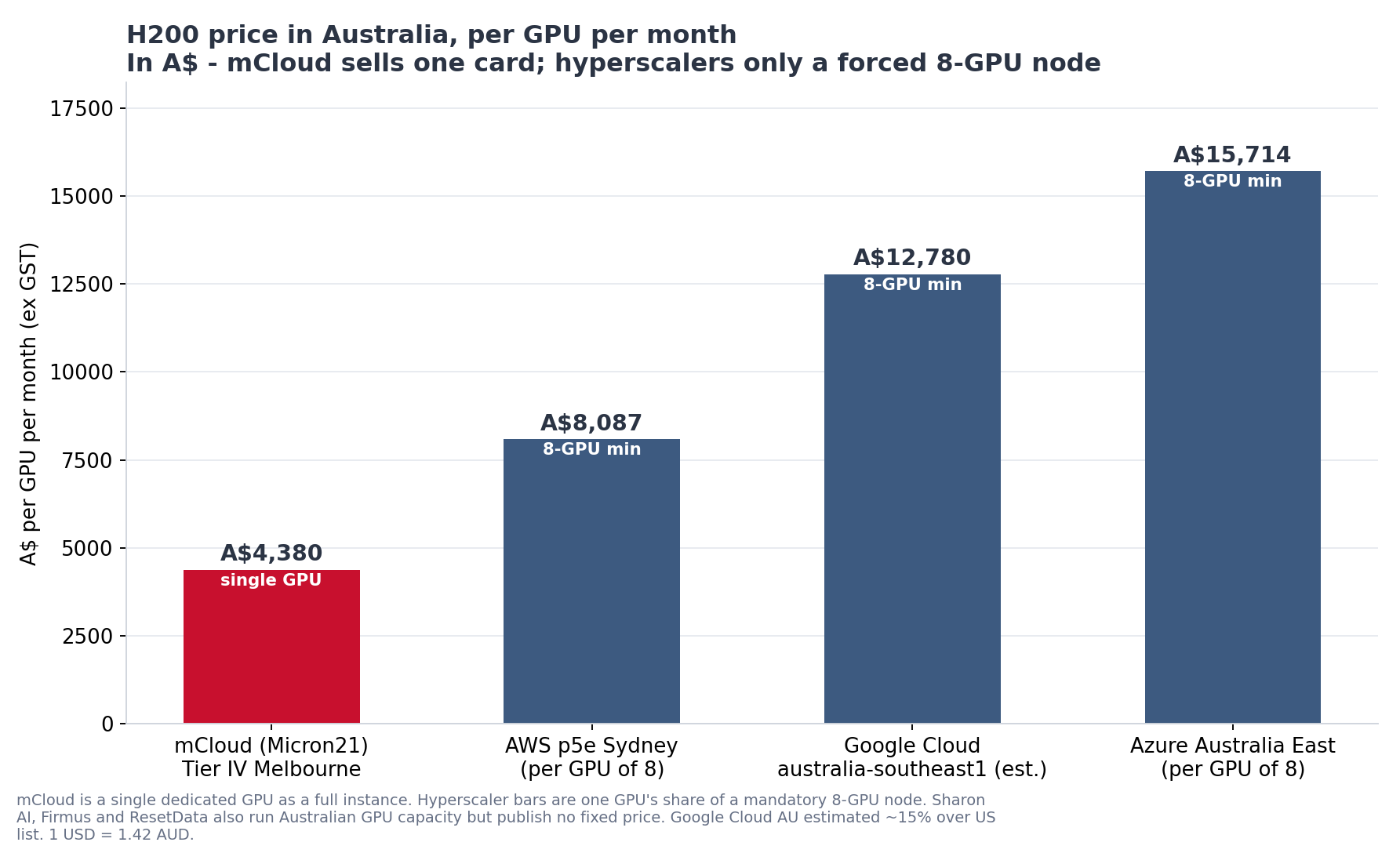
The trap is this: at every hyperscaler, and at CoreWeave and Oracle, the smallest H200 you can buy is eight of them. AWS sells the H200 only inside the eight-GPU p5e.48xlarge and p5en.48xlarge instances. Azure's ND H200 v5 series comes in exactly one size: eight GPUs. Google Cloud's A3 Ultra machine type is a3-ultragpu-8g, and the name says it. Oracle's BM.GPU.H200.8 is an eight-GPU bare-metal node. Unlike the older H100 generation, where AWS and Google both eventually offered one-, two- and four-GPU shapes, no hyperscaler sells a single H200 anywhere in the world. If your workload needs one card, the hyperscaler minimum bill is the whole node.
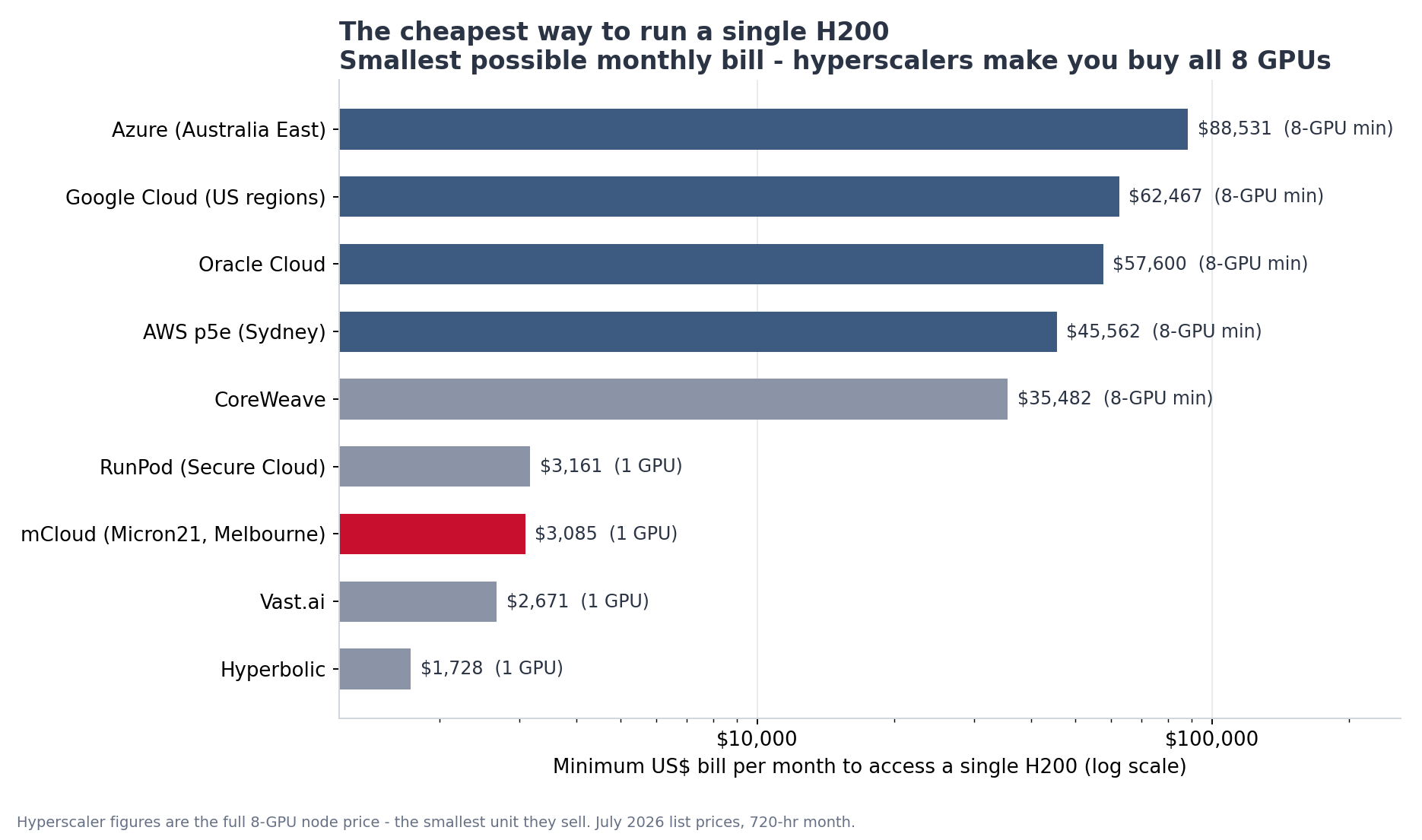
In monthly terms the minimum spend to touch a single H200 is roughly US$45,600 on AWS in Sydney, US$62,500 on Google Cloud, US$57,600 on Oracle, and US$88,500 on Azure Australia East, because you are paying for eight cards whether you use them or not. On mCloud the minimum is one card: A$4,380 a month, about US$3,085. That is not a 20 or 30 percent difference. It is a fifteen-to-thirty-times difference in the cheque you actually write.
The full comparison: seventeen providers, one card, July 2026
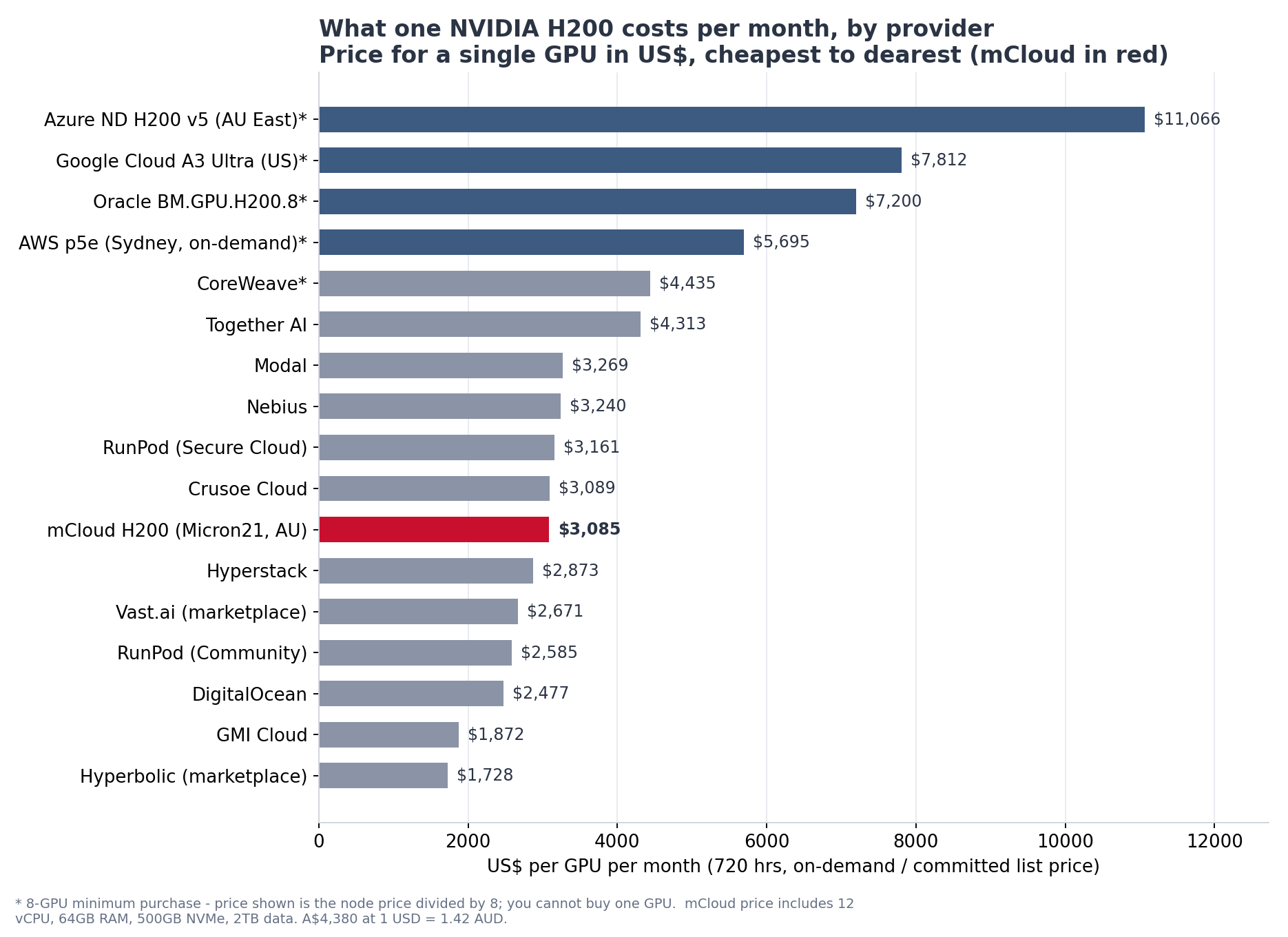
The table below is the complete landscape of published H200 pricing. Prices are July 2026 public list prices, on-demand or standard committed rate, normalised to one GPU for a 720-hour month. Where a provider only sells 8-GPU nodes, the per-GPU figure is the node price divided by eight and marked, remembering that you cannot actually buy that eighth. The mCloud figure is our published price and includes the full instance: 12 vCPU Xeon Gold cores, 64GB RAM, 500GB NVMe, 2TB of data transfer, an IP address and DDoS protection. Every other row is GPU compute only.
| Provider | US$/GPU-hr | US$/GPU/month | Smallest unit | Hosted | Model |
|---|---|---|---|---|---|
| Hyperbolic | $2.40 | ~$1,728 | 1 GPU | US, variable hosts | Marketplace |
| GMI Cloud | $2.60 | ~$1,872 | 1 GPU | US/Asia | Neocloud |
| DigitalOcean | $3.44 | ~$2,477 | 1 GPU | US/EU | Neocloud |
| RunPod (Community) | $3.59 | ~$2,585 | 1 GPU | Global, variable hosts | Marketplace tier |
| Vast.ai | $3.71 | ~$2,671 | 1 GPU | Global, variable hosts | Marketplace |
| Hyperstack | $3.99 | ~$2,873 | 1 GPU | EU/US | Neocloud |
| Crusoe Cloud | $4.29 | ~$3,089 | 1 GPU | US | Neocloud |
| mCloud H200 (Micron21) | ~$4.28 (A$6.08) | ~$3,085 (A$4,380) | 1 GPU, full instance | Australia, Tier IV Melbourne | Sovereign full-stack |
| RunPod (Secure Cloud) | $4.39 | ~$3,161 | 1 GPU | US/EU data centres | Neocloud |
| Nebius | $4.50 | ~$3,240 | 1 GPU | US/EU | Neocloud |
| Modal | $4.54 | ~$3,269 | Serverless | US | Serverless |
| Together AI | $5.99 | ~$4,313 | 1 GPU | US | Neocloud |
| CoreWeave | $6.16* | ~$4,435* | 8-GPU node ($49.28/hr) | US/EU | Neocloud |
| AWS p5e (Sydney) | $7.91* | ~$5,695* | 8-GPU node ($63.28/hr) | Australia (Sydney) | Hyperscaler |
| Oracle BM.GPU.H200.8 | $10.00* | ~$7,200* | 8-GPU node ($80/hr) | US | Hyperscaler |
| Google Cloud A3 Ultra (US) | $10.85* | ~$7,812* | 8-GPU node ($86.76/hr) | US (AU ~15% higher) | Hyperscaler |
| Azure ND H200 v5 (AU East) | $15.37* | ~$11,066* | 8-GPU node ($122.96/hr) | Australia (Sydney) | Hyperscaler |
* Node price divided by 8. The provider does not sell fewer than eight GPUs. Sources and dates in the verification section below. USD converted at 1 USD = 1.42 AUD, the H1 2026 average.
The honest section: who is cheaper than us, and why
We could have cropped that table to make ourselves the cheapest. We did not, because the buyers we want are the ones who check. So here it is plainly: the cheapest H200 in the world is Hyperbolic, at about US$2.40 per GPU-hour, roughly 44 percent below mCloud. GMI Cloud, DigitalOcean, RunPod's Community tier and Vast.ai also list lower headline rates than we do.
What do those prices buy? Hyperbolic and Vast.ai are marketplaces. They do not own the GPUs; they aggregate spare capacity from third-party hosts, including mining operations, small data centres and resellers, and the price floats with supply. The hardware behind your instance varies, capacity can disappear when a host withdraws it, there is no enterprise SLA, and your data lives on someone else's hardware in another country, under that country's laws. RunPod's Community tier is the same model. These platforms are excellent for what they are built for: researchers and developers burning through short experiments where an interruption costs an afternoon, not a business. We genuinely recommend them for that. They are not comparable products for production workloads, and they are certainly not comparable for any workload where Australian data residency matters.
The fairer comparison is the dedicated, data-centre-hosted neoclouds, and there the picture changes. mCloud at about US$4.28 an hour is cheaper than RunPod's Secure Cloud tier (US$4.39), within one cent an hour of Crusoe (US$4.29), cheaper than Nebius (US$4.50), Modal (US$4.54) and Together AI (US$5.99), and around 30 percent below CoreWeave's per-GPU rate, which you cannot buy singly anyway. And the mCloud figure is not GPU-only. It includes the CPU, memory, storage, data allowance, IP address and DDoS protection that the others sell separately or not at all. Stack that against the fact that every one of those providers hosts your workload in the United States or Europe, and the value question inverts: the only providers meaningfully cheaper than a sovereign Australian H200 are offshore marketplaces without SLAs.
One card to eight: how mCloud pricing scales
Unlike the hyperscalers, which sell exactly eight, and most neoclouds, which sell exactly one, an mCloud instance scales from one to eight dedicated H200 cards, and the supporting resources scale with it. The per-card price falls as you grow, because you are not paying a new instance overhead for every card. These are the real published configurations from the mCloud calculator, ex GST:
| Configuration | 1x H200 | 4x H200 | 8x H200 |
|---|---|---|---|
| NVIDIA H200 GPUs (141GB each) | 1 ($3,900 + base) | 4 ($15,600) | 8 ($31,200) |
| vCPU cores (Xeon Gold) | 12 | 48 ($480) | 96 ($960) |
| Memory / RAM | 64GB | 256GB ($640) | 512GB ($1,280) |
| mSAN Performance NVMe | 500GB | 500GB ($140) | 500GB ($140) |
| Metered data included | 2TB ($50) | 2TB ($50) | 2TB ($50) |
| IP address | 1 ($10) | 1 ($10) | 1 ($10) |
| DDoS protection | Shield included | Shield included | Shield included |
| Total per month (ex GST) | A$4,380 | A$16,920 | A$33,640 |
| Effective price per card | A$4,380 | A$4,230 | A$4,205 |
Contract length 12 months, billed monthly, self-managed with self setup; managed care plans available. GPU memory totals: 141GB, 564GB and 1,128GB (1.1TB) of HBM3e respectively.
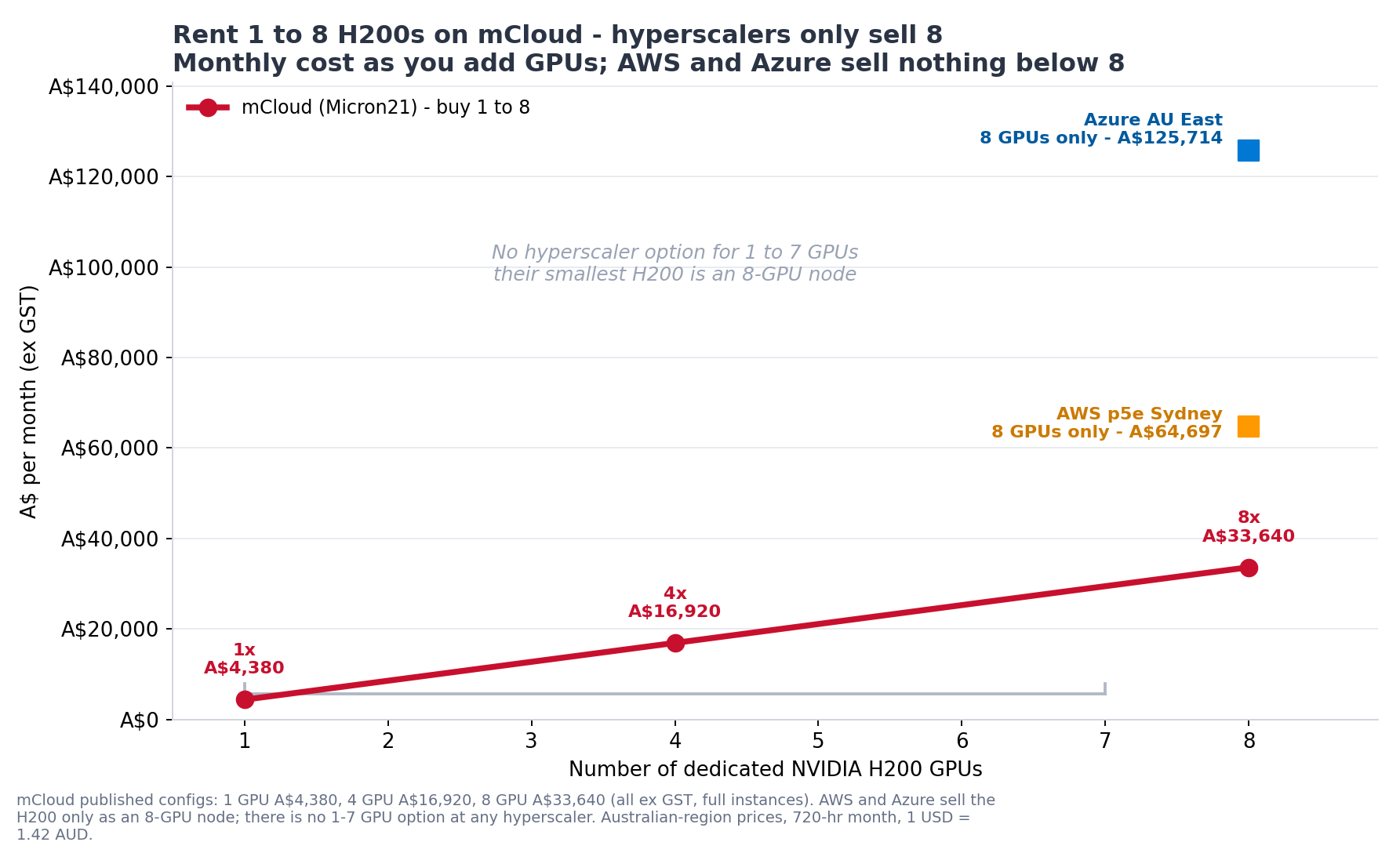
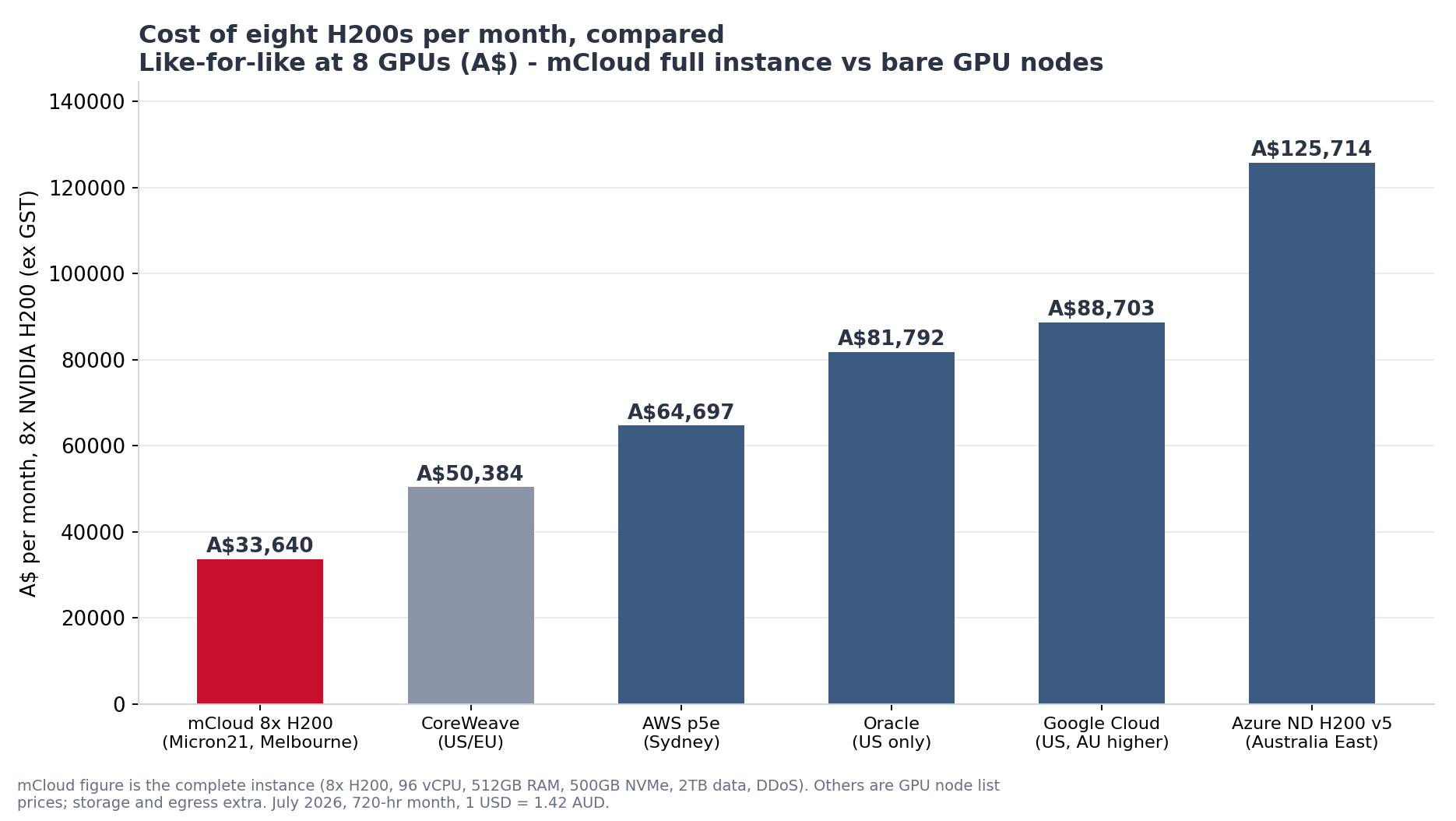
The eight-card configuration is where the comparison with the rest of the market gets uncomfortable for everyone else, because eight cards is the quantity the hyperscalers force you to buy, so for once the comparison is exactly like for like. Eight dedicated H200s on mCloud, with 96 cores, 512GB of RAM, storage, data and DDoS protection included, cost A$33,640 a month. The same eight GPUs cost about A$50,400 a month on CoreWeave, A$64,700 on AWS in Sydney, A$81,800 on Oracle in the US, A$88,700 on Google Cloud in the US (more in the Australian region), and A$125,700 on Azure Australia East, all as bare GPU nodes with storage and egress still to add. At the hyperscalers' own minimum quantity, mCloud is 33 percent cheaper than the cheapest neocloud that sells that shape, half the price of AWS Sydney, and roughly a quarter of Azure's Australian price.
What A$4,380 actually includes (and what a GPU-hour elsewhere does not)
Neocloud pricing is quoted per GPU-hour because it makes the number small. But a GPU cannot run a workload by itself, and the extras are where quoted prices and real invoices part company. Here is the like-for-like:
| mCloud H200 (A$4,380/mo) | Typical neocloud pod | Hyperscaler 8-GPU node | |
|---|---|---|---|
| GPU | 1 to 8 dedicated H200 141GB, passthrough | 1x H200 (shared host common) | 8x H200 (minimum) |
| vCPU / RAM | 12 cores / 64GB included, scales with GPUs | Varies, often billed separately | Included in node price |
| Storage | 500GB NVMe included | Extra, ~US$0.10-0.20/GB/mo | Extra (EBS/managed disk) |
| Data transfer | 2TB included, then A$50 per 2TB (~2.5c/GB) | Often free, sometimes metered | ~US$0.09-0.114/GB egress |
| DDoS protection | Included (Micron21 global scrubbing) | Rarely included | Paid tier |
| Support | 24/7 Australian engineers, on site, SLA | Ticket/Discord, best effort | Paid support plans |
| Facility | Tier IV certified, Zone 4 PSPF, Melbourne | Varies, mostly Tier III US/EU | Hyperscaler regions |
| Data jurisdiction | Australia, Australian-owned operator | US/EU, foreign operator | AU region available, foreign operator |
| Billing | A$, fixed, ex GST | US$, usage-based | US$, usage-based |
The Australian sovereign GPU market: who exists, and who publishes a price
This is the section we most wanted to write, because we went looking for our Australian competition properly. Australia now has a genuine sovereign GPU sector: Sharon AI runs GPU capacity including H200s from NEXTDC facilities in Melbourne and Sydney. Firmus is building very large AI factories in Tasmania and Melbourne under Project Southgate, with tens of thousands of next-generation GPUs on order, much of it pre-committed to hyperscale customers. ResetData operates AI-F1, billed as Australia's first sovereign public AI factory, a 1,024-GPU NVIDIA H200 cluster in a Centuria-managed facility at 818 Bourke Street in Melbourne, backed by ASX-listed Centuria Capital Group and sold both directly and through distribution via Dicker Data. Vault Cloud runs government-focused sovereign cloud in Canberra and Sydney with older V100 accelerators. Scaile, built by xAmplify with AUCloud, offers a secure DGX A100 platform for government. Macquarie Cloud Services has launched GPU-optimised AI infrastructure in its sovereign facilities. This is a real ecosystem and its existence is good for Australia.
Now try to find a price. We checked every one of those providers' websites in the first week of July 2026, and the result is remarkable: not one Australian-owned GPU provider other than Micron21 publishes a price for any current-generation GPU, anywhere online. Sharon AI: contact sales. Firmus: a calculator that ends in an enquiry form, with committed pricing by negotiation. ResetData: a sign-up portal and channel partners, with no GPU rate on the public website. Vault Cloud, Scaile, Macquarie Cloud Services: quote, quote, quote. The only published H200 prices you can find for Australian-hosted capacity are the hyperscalers', in US dollars, at eight cards a time, on foreign-owned platforms, and ours.
| Provider | Australian owned? | GPU capacity in Australia | Published price online? |
|---|---|---|---|
| Micron21 mCloud | Yes, 100% | H200, H100, A100, A10, RTX A6000; Tier IV Melbourne | Yes. A$4,380/mo per H200, on the website and calculator |
| Sharon AI | Yes | H200/H100 in NEXTDC Melbourne and Sydney | No. Sales quote only |
| Firmus | Majority Australian | AI factories, Tasmania and Melbourne (GB300 era) | No. Calculator ends in enquiry; committed pricing negotiated |
| ResetData | Yes | AI-F1: 1,024x H200, Centuria facility, Melbourne CBD | No public GPU price. Sign-up platform, sales and channel (Dicker Data) |
| Vault Cloud | Yes | V100-era accelerators, Canberra/Sydney | No. Quote only |
| Scaile (xAmplify/AUCloud) | Yes | DGX A100, government-focused | No. Quote only |
| Macquarie Cloud Services | Yes | GPU-optimised AI infrastructure, Sydney/Canberra | No. Quote only |
| AWS / Azure / Google Cloud | No | H200 8-GPU nodes, Sydney | Yes, in USD, 8-GPU minimum |
We considered leaving the unpriced providers out of this article entirely; a price comparison arguably has no room for providers without prices. We kept them in for two reasons. First, buyers deserve to know the whole Australian field, and several of these operators are doing important work. Second, the pattern is the point. Opaque pricing is a choice, and it is usually a choice that favours the seller. Transparent pricing is also a choice; it means anyone, including our competitors, can undercut us tomorrow, and we publish anyway, because we think a sovereign capability you cannot price without a sales call is not really a public capability at all.
The same invisibility shows up internationally. The global GPU price-comparison sites that buyers actually use, GetDeploying (66 providers tracked), gpuperhour.com (28 providers), Thunder Compute's monthly H200 index and ComputeStacker's marketplace, list almost no Australian capacity at all. ComputeStacker's "Best GPU Cloud Providers in Australia" page lists exactly one provider, and it is a US edge platform, not an Australian company. As far as the global GPU market is concerned, sovereign Australian GPU capacity barely exists, and part of the reason is that capacity without a published price cannot be indexed. That is a problem for the whole Australian sector, and publishing real prices is our contribution to fixing it.
Egress: the fee that quietly doubles hyperscaler AI bills
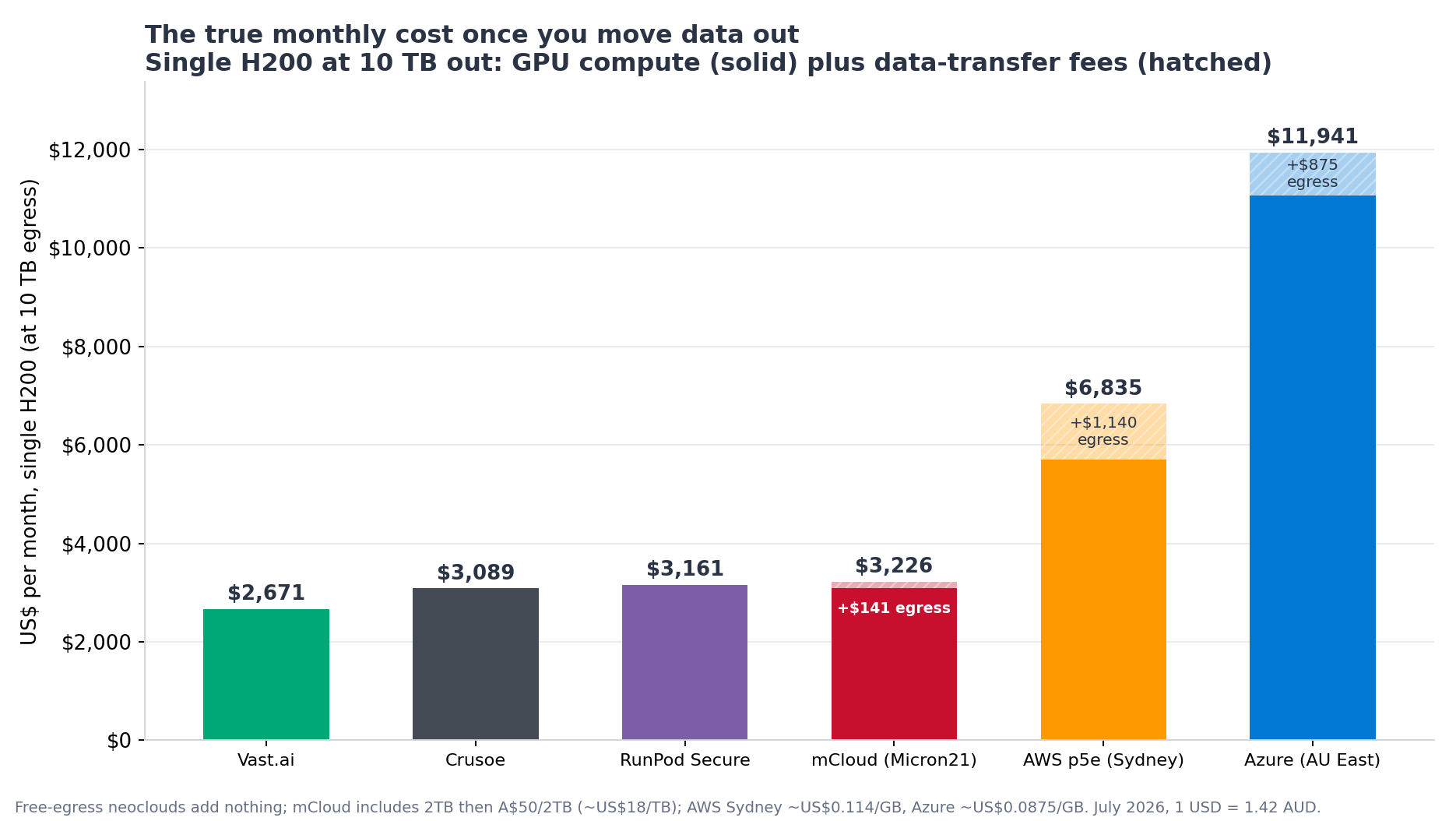
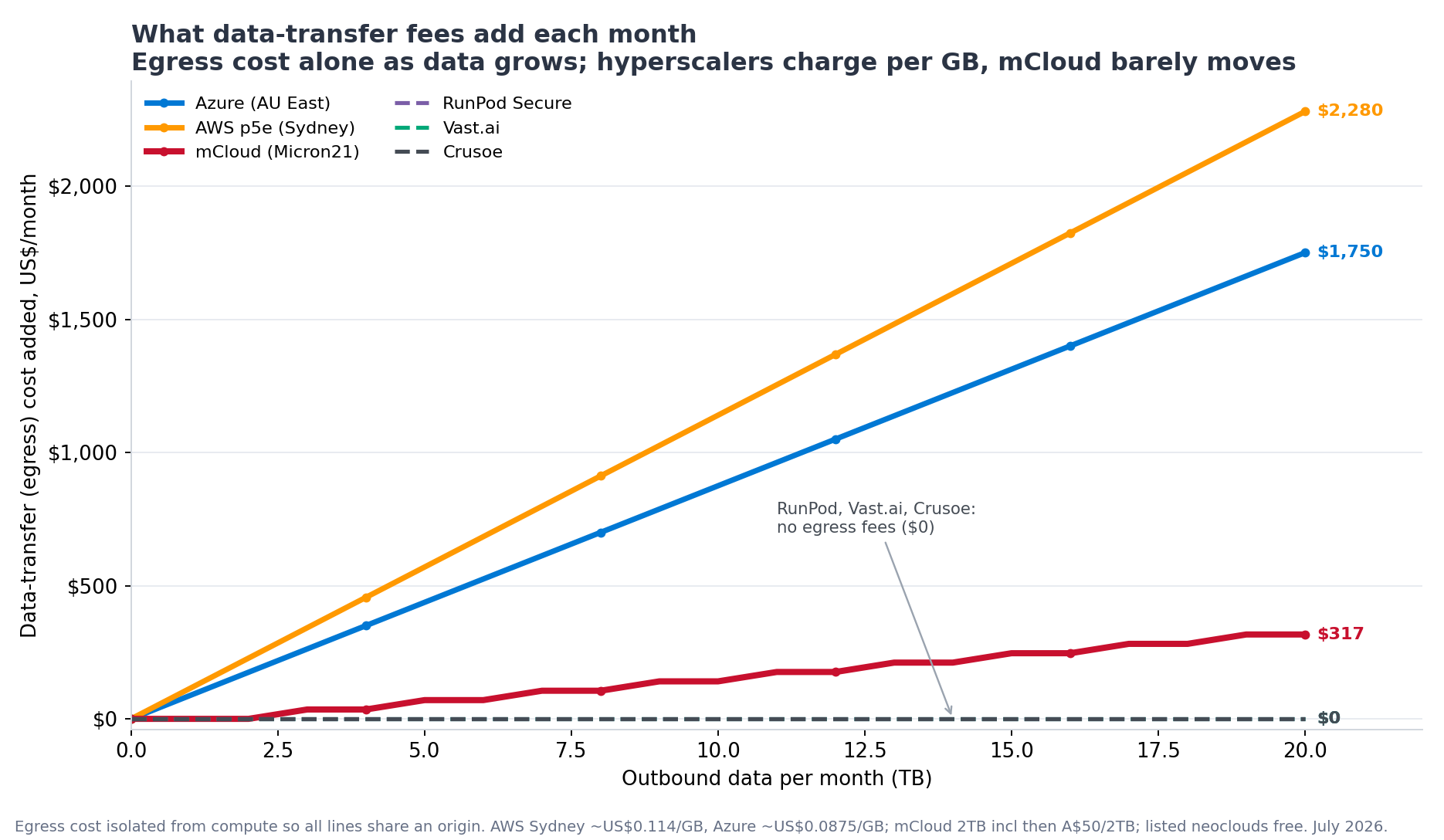
AI workloads move data. Model weights run to tens or hundreds of gigabytes, training sets larger still, and production inference generates a constant stream of outputs, logs and backups. The hyperscalers charge for every gigabyte that leaves: roughly US$0.114 per GB out of AWS Sydney and about US$0.0875 per GB out of Azure after small free allowances. Pull one terabyte of models and datasets out per month and that is US$90 to $114 on top of compute. Industry analyses consistently find egress, storage and ancillary fees add 20 to 40 percent to hyperscaler AI invoices, and it is the single most common source of bill shock we hear about from customers migrating to us.
The neoclouds are better here; RunPod and most competitors do not meter egress. So are we: every mCloud instance includes 2TB of transfer, counted across inbound and outbound, with additional data at A$50 per 2TB block, about two and a half Australian cents per gigabyte. For most single-GPU workloads the included 2TB means data transfer costs nothing extra at all. The chart below shows the effect on a single-H200 bill as monthly data volume grows: the hyperscaler lines climb steadily; the mCloud line barely moves.
Billing terms: the trade-off we will not hide
One more difference belongs in the open. The neoclouds bill by the hour or the second with no commitment; the mCloud H200 is billed monthly on a 12-month term with no upfront payment. If your need is a card for a weekend of experiments, an hourly provider is the right tool and we will say so. The 12-month term exists because the price is built on dedicated hardware reserved for you in a Tier IV facility, not on a marketplace's floating spare capacity, and it is also why the price can be this sharp.
Two things keep the comparison fair. First, the committed prices at the neoclouds and hyperscalers are lower than their on-demand rates too, but they require sales negotiations and typically one-to-three-year terms of their own; ours is simply the published price. Second, for the workloads an H200 is actually bought for in production, inference APIs, fine-tuning pipelines, and sovereign AI platforms running 24/7, twelve months is not a constraint. It is the shape of the workload. A production H200 running around the clock on RunPod Secure Cloud costs more per month than mCloud from day one, with no Australian residency and no SLA. The commitment buys you a lower price, a fixed Australian dollar bill, and hardware that is yours.
Sovereignty and certification: the difference that does not fit in a price table
Everything above is arithmetic. This part is not. The data that AI workloads touch, patient records, case files, financial models, government datasets, and the proprietary model weights themselves, is usually exactly the data that should not sit under foreign jurisdiction. A hyperscaler region inside Australia narrows the exposure but cannot remove it: the platform is foreign-owned and foreign-operated. A US neocloud or marketplace does not even narrow it.
The mCloud H200 runs in Micron21's own data centre in Melbourne, on our own network, behind our own DDoS mitigation, operated by our own Australian staff, in a business that is 100 percent Australian owned. For government, defence and regulated-industry buyers, the certifications are the shortlist, so here they are in one place:
| Requirement | Micron21 status |
|---|---|
| Facility certification | Australia's first Uptime Institute Tier IV certified data centre (Melbourne) |
| Physical security | Zone 4 PSPF facility |
| Government hosting | Certified provider under the Australian Government Hosting Certification Framework (HCF) |
| Security assessment | IRAP assessed to PROTECTED |
| Defence industry | DISP (Defence Industry Security Program) member |
| Standards | ISO 27001, 27002, 27018, 14520; PCI compliant |
| Ownership | 100% Australian owned and operated; no foreign parent |
| Network | Own global network, AS38880, 700Gbit+ capacity, own DDoS scrubbing |
To our knowledge, no neocloud in the global price table above holds any Australian government certification, and none is eligible to. Among the Australian sovereign providers, several hold strong credentials for government work, and we say so plainly; what none of them offers is those credentials plus a published price plus a single-card H200 you can order today. For healthcare, legal, financial services, defence-adjacent and government AI workloads, that combination is frequently the entire decision.
Which provider actually fits your workload
An honest comparison ends with honest guidance. If you need thousands of H200s interconnected for frontier-scale training, that is CoreWeave's and the hyperscalers' business, and the ecosystems are real. If you need a cheap card for a day of experiments and an interruption costs you nothing, use Vast.ai or Hyperbolic and enjoy the price floor; we mean it. If your stack is already deep inside AWS and the GPU must sit next to AWS managed services, Sydney p5e capacity exists, at eight cards a time. If you are a federal agency whose framework mandates a specific panel arrangement, some of the Australian sovereign providers above may already be on your panel, and you should talk to them, with a quote request, because that is the only way you will learn their price.
The mCloud H200 is the right answer when the requirement reads like this: one to eight dedicated H200s, running production workloads, with data that stays in Australia under an Australian-owned operator, a bill that is fixed in Australian dollars and published before you ever speak to anyone, government-grade facility and security certification, and an engineer who answers at 2am from the same building as your hardware. That describes most serious Australian AI deployments we see. For that requirement, nothing in this article's seventeen-provider table beats it on price, and nothing beats it at all once sovereignty is a requirement rather than a preference.
Frequently asked questions
How much does an NVIDIA H200 cost per month in Australia?
A$4,380 ex GST on Micron21 mCloud for a complete single-GPU instance (12 vCPU, 64GB RAM, 500GB NVMe, 2TB data, DDoS protection). Instances scale to eight cards: A$16,920 for four H200s and A$33,640 for eight, which works out to A$4,205 per card with 96 cores and 512GB of RAM included. The hyperscaler alternatives in Australia start at roughly A$64,700 a month because they only sell 8-GPU nodes.
Can I rent a single H200 on AWS, Azure or Google Cloud?
No. All three, plus Oracle and CoreWeave, sell the H200 exclusively in 8-GPU configurations. No hyperscaler sells a single H200 anywhere in the world as of July 2026.
Which Australian GPU providers publish their prices?
To the best of our research in July 2026, Micron21 is the only Australian-owned GPU provider with a published, self-serve price on current-generation GPU capacity. Sharon AI, Firmus, ResetData, Vault Cloud, Scaile and Macquarie Cloud Services all operate sovereign GPU infrastructure and all require a sales conversation to learn a price.
Who has the cheapest H200 on the planet?
Marketplace platforms: Hyperbolic from about US$2.40 per GPU-hour and GMI Cloud from about US$2.60. They are US-hosted, variable-host marketplaces without enterprise SLAs. Among dedicated, data-centre-hosted providers, mCloud at about US$4.28 an hour all-inclusive is cheaper than RunPod Secure Cloud and within one cent an hour of Crusoe.
Is Micron21 certified for government and defence workloads?
Yes: DISP member, IRAP assessed to PROTECTED, Zone 4 PSPF facility, HCF certified provider, Tier IV data centre, ISO 27001/27002/27018/14520 and PCI compliant, 100 percent Australian owned.
H200 vs H100: which should I choose?
Choose the H200 when the model or context overflows 80GB: 70B-class models on a single card, long-context inference, memory-bound fine-tuning. If your model fits comfortably in 80GB, an H100 is usually better value. mCloud offers both, from a single card.
Does the A$4,380 price include GST and data transfer?
The price is ex GST and includes 2TB of monthly data transfer, with additional transfer at A$50 per 2TB block. There are no egress surprises and no US-dollar exchange exposure.
Pricing sources and verification
Every competitor figure was checked in the first week of July 2026 against the provider's own pricing page or pricing API, cross-referenced with independent trackers. Prices change frequently, so treat these as a point-in-time reference and confirm the current rate at the source. Exchange rate: all conversions use 1 USD = 1.42 AUD, the average for the first half of 2026, consistent with our A100 comparison. Currency risk applies only to competitors: their pricing is set in US dollars, so an Australian buyer's bill rises whenever the Australian dollar weakens, whereas mCloud is priced and billed in Australian dollars.
Providers compared in this article: official sites and pricing pages
| Provider | Website | Pricing source we used |
|---|---|---|
| Micron21 mCloud | micron21.com | mCloud H200 product page and pricing calculator |
| AWS | aws.amazon.com | EC2 Capacity Blocks pricing, P5 instance family, on-demand pricing and data transfer |
| Microsoft Azure | azure.microsoft.com | Azure Retail Prices API (ND96isr H200 v5), ND H200 v5 documentation |
| Google Cloud | cloud.google.com | Accelerator-optimized VM pricing, GPU pricing |
| Oracle Cloud | oracle.com/au/cloud | OCI GPU instance pricing |
| CoreWeave | coreweave.com | coreweave.com/pricing |
| RunPod | runpod.io | runpod.io/pricing |
| Nebius | nebius.com | nebius.com/prices |
| Crusoe Cloud | crusoe.ai | crusoe.ai/cloud/pricing |
| DigitalOcean | digitalocean.com | GPU Droplets pricing |
| Together AI | together.ai | together.ai/pricing |
| Modal | modal.com | modal.com/pricing |
| Hyperstack | hyperstack.cloud | GPU pricing |
| GMI Cloud | gmicloud.ai | H200 pricing guide |
| Vast.ai | vast.ai | vast.ai/pricing (live marketplace rates) |
| Hyperbolic | hyperbolic.ai | GPU marketplace |
Australian sovereign GPU providers surveyed (no published pricing found, July 2026)
| Provider | Website | What we checked |
|---|---|---|
| Sharon AI | sharonai.com | Products and sovereign AI pages; no rate card |
| Firmus | firmus.co | firmus.co/pricing; calculator ends in enquiry, committed pricing negotiated |
| ResetData | resetdata.com.au | AI platform and AI-F1 launch announcement; sign-up portal, no public GPU rate |
| Vault Cloud | vaultcloud.com.au | Performance/accelerator pages; quote only |
| Scaile (xAmplify/AUCloud) | scaile.com.au | Full site; quote only |
| Macquarie Cloud Services | macquariecloudservices.com | Private cloud / AI pages; quote only |
Independent pricing trackers and other data sources
| Source | Link | Used for |
|---|---|---|
| Thunder Compute H200 index | thundercompute.com H200 price comparison | Cross-check of neocloud H200 rates, July 2026 snapshot |
| GetDeploying | getdeploying.com H200 pricing (31+ providers) | Cross-check of rates, billing models and availability |
| gpuperhour.com | gpuperhour.com | Secondary rate cross-check (28 providers) |
| ComputeStacker | Australia provider listings | Evidence of Australian capacity invisibility on global trackers |
| Vantage (instances.vantage.sh) | p5en.48xlarge, ND96isr H200 v5 | AWS and Azure instance rate verification |
| CloudPrice | AWS p5e, GCP a3-ultragpu-8g | Regional availability (including Sydney and australia-southeast1/2) |
| Northflank cloud index | p5e.48xlarge regions | AWS Sydney availability confirmation |
| Reserve Bank of Australia | RBA exchange rates | AUD/USD conversion basis (1 USD = 1.42 AUD, H1 2026 average) |
The bottom line
Same silicon, a six-fold price spread, and four questions that decide it. Can you buy one card, or must you buy eight? Does your data stay in Australia, under an Australian owner? Is the price on the website, or behind a sales call? And does the operator own the stack it is selling you? The hyperscalers fail the first question and the second. Every neocloud fails the second. Every other Australian provider fails the third. Most of the market fails the fourth. The mCloud H200, from one dedicated card at A$4,380 a month to eight at A$33,640, everything included, in a Tier IV, Zone 4, IRAP-assessed, Australian-owned facility, is the only offer in the market that passes all four, and it is priced below most of the providers that pass none of them.
Compare it for yourself. Build your H200 configuration, from one card to eight, and see the real Australian dollar price: mCloud Pricing Calculator
