
mCloud Cloud Servers and Virtual Data Centre vs AWS, Azure and Google: Australian Pricing Compared
03 Jul 2026, by James Braunegg, CEO and Founder, Micron21
Most cloud spending is not exotic. It is ordinary general-purpose compute: the virtual machines that run websites, databases, applications and back-office systems. This is also where Australian businesses quietly overpay the global hyperscalers the most, month after month, for capacity that costs far less to deliver locally. This article compares mCloud cloud servers and our virtual data centre directly against AWS Azure Google Cloud, on matched hardware and a matched build, so the real difference is clear.
Two principles make the comparison fair. The first is the hardware. mCloud runs second-generation Intel Xeon Scalable processors, the Cascade Lake generation, with 24 cores per CPU, across both the Gold series at 2.6GHz and the Platinum series at 2.9GHz. The fair counterparts are the hyperscalers' Cascade Lake general-purpose families: AWS M5 and M5n, Azure Dv4 and Dsv4, and Google N2, which run at broadly similar base clocks of around 2.5 to 2.6GHz. So this is a genuine like-for-like comparison of the same processor generation, with mCloud's Platinum tier at the faster end of that range.
Just as the hyperscalers offer several processor families and generations, so does Micron21, and the figures here use our default cloud server CPU, the second-generation Xeon Platinum and Gold described above, because that is the like-for-like equivalent of the hyperscalers' default general-purpose families. For workloads with different needs Micron21 also offers an older, lower-cost T series built on Intel E5 processors, plus third and fourth-generation Xeon on request, but to keep this comparison fair it uses the default option on both sides.
The second principle is the commercial basis. mCloud is billed month to month, with no lock-in and no upfront commitment, so the honest equivalent on the hyperscalers is their on-demand pricing, which is also month to month, not their one or three-year committed rates that require you to lock capacity in for years. The hyperscalers can be made cheaper by committing for one to three years, but that is a different product with very different flexibility, and mCloud gives you the low price without the lock-in. Every hyperscaler figure here is Australian-region on-demand, and US dollar prices are converted at 1 USD = 1.42 AUD, the average for the first half of 2026.
How mCloud sells compute: instances and the virtual data centre
mCloud gives you two ways to buy. The first is fixed instances, our m1 series, much like a hyperscaler instance type. An m1.xlarge is A$339.00 a month and includes 8 cores at 2.9GHz, 32GB of memory, 200GB of fast NVMe storage, 2TB of data, DDoS protection and a static IPv4 address, with a full ladder of sizes from m1.micro up through m1.large, m1.xlarge, m1.2xlarge and beyond.
The second, where the real savings appear at scale, is the virtual data centre (VDC). Instead of fixed instances you buy a pool of resources and carve it into any virtual machines you like. The VDC comes in three pricing tiers, the only difference being the cost of the resources, so you pick the tier that matches your scale.
| VDC resource, per month (ex GST) | Performance | Bulk | Dedicated |
|---|---|---|---|
| Per CPU core | A$12.00 | A$10.00 | A$5.74 |
| Per GB of memory | A$3.50 | A$2.50 | A$2.25 |
Storage is bought separately, 500GB minimum, across four types so you only pay for the performance you need.
| Storage, per month | Per 500GB | Per GB |
|---|---|---|
| NVMe performance | A$140.00 | A$0.28 |
| NVMe encrypted | A$165.00 | A$0.33 |
| Hybrid | A$75.00 | A$0.15 |
| Bulk SAS | A$30.00 | A$0.06 |
It is worth being clear about what that storage is. mCloud's performance tier is genuine high-speed NVMe, whereas the hyperscalers' default disks are general-purpose SSD with far lower guaranteed IOPS, and their faster provisioned-IOPS volumes cost considerably more again. So the like-for-like in the cost tables, which puts mCloud NVMe against hyperscaler SSD, is if anything generous to the hyperscalers.
Every mCloud storage tier is also fully redundant by design. It runs on Ceph and is 3N: three copies of your data are written in triplicate and placed across separate disks and nodes according to CRUSH maps, so the loss of a drive, or even a whole storage node, never loses data and never takes your storage offline. That resilience is built into the price of every tier above, not a paid add-on.
Data is simple: every configuration includes 2TB of transfer (about 1TB in and 1TB out) for A$50.00. Beyond that, add 2TB blocks at A$50.00 each, or take a 100 megabit unlimited plan for A$400.00 a month, or a 1 gigabit unlimited plan for A$1,300.00. There are no surprise per-gigabyte egress charges of the kind the hyperscalers apply.
Building the same machine on every platform
The fairest comparison is to build the identical machine on each platform and add up the real monthly cost, including storage and data. The three builds below span a single small server, a typical mid-sized workload, and a larger configuration of the kind a business moving off a hyperscaler would actually run, each with 500GB or more of fast SSD and 1TB of outbound data, matched across all four providers.
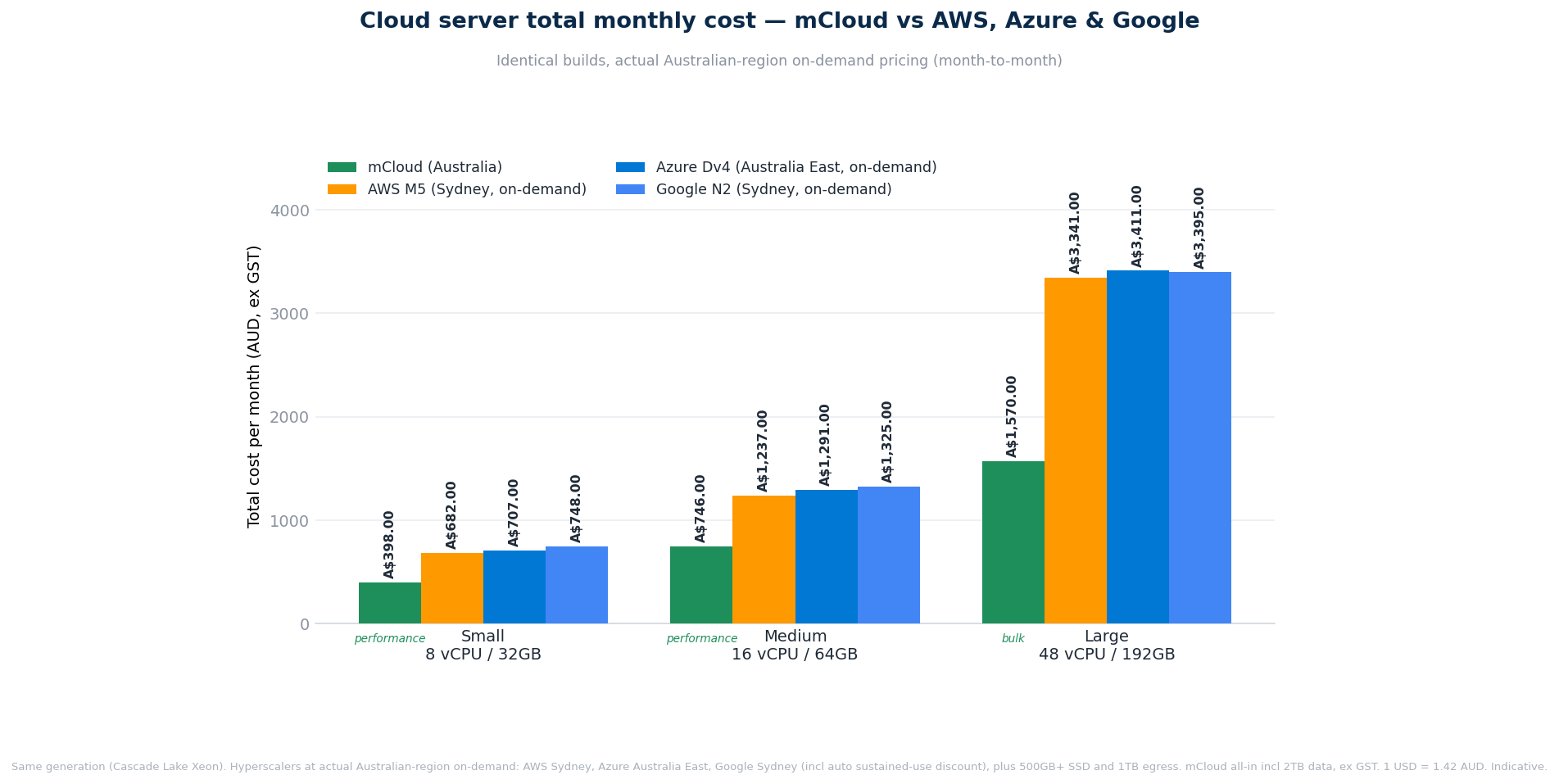
| Identical build, per month | mCloud | AWS M5 (Sydney) | Azure Dv4 (Aus East) | Google N2 |
|---|---|---|---|---|
| Small: 8 vCPU, 32GB, 500GB SSD | A$398.00 | A$682.00 | A$707.00 | A$748.00 |
| Medium: 16 vCPU, 64GB, 1TB SSD | A$746.00 | A$1,237.00 | A$1,291.00 | A$1,325.00 |
| Large: 48 vCPU, 192GB, 2TB SSD | A$1,570.00 | A$3,341.00 | A$3,411.00 | A$3,395.00 |
On the small build, mCloud is about 43 percent cheaper than AWS and roughly half the cost of Google Cloud, on the same-generation hardware and the same month-to-month flexibility. The mCloud figure even uses NVMe performance storage, the premium tier; with hybrid or bulk SAS storage the gap is wider again.
The more you buy, the cheaper mCloud gets
The single most important point for any organisation moving more than one or two machines: hyperscaler pricing is essentially linear, so ten times the capacity costs roughly ten times the money, whereas mCloud's virtual data centre tiers get cheaper per unit as you scale. A small workload sits in the performance tier; a larger estate moves into bulk; the largest deployments use dedicated, where a core costs less than half what it does in the performance tier.
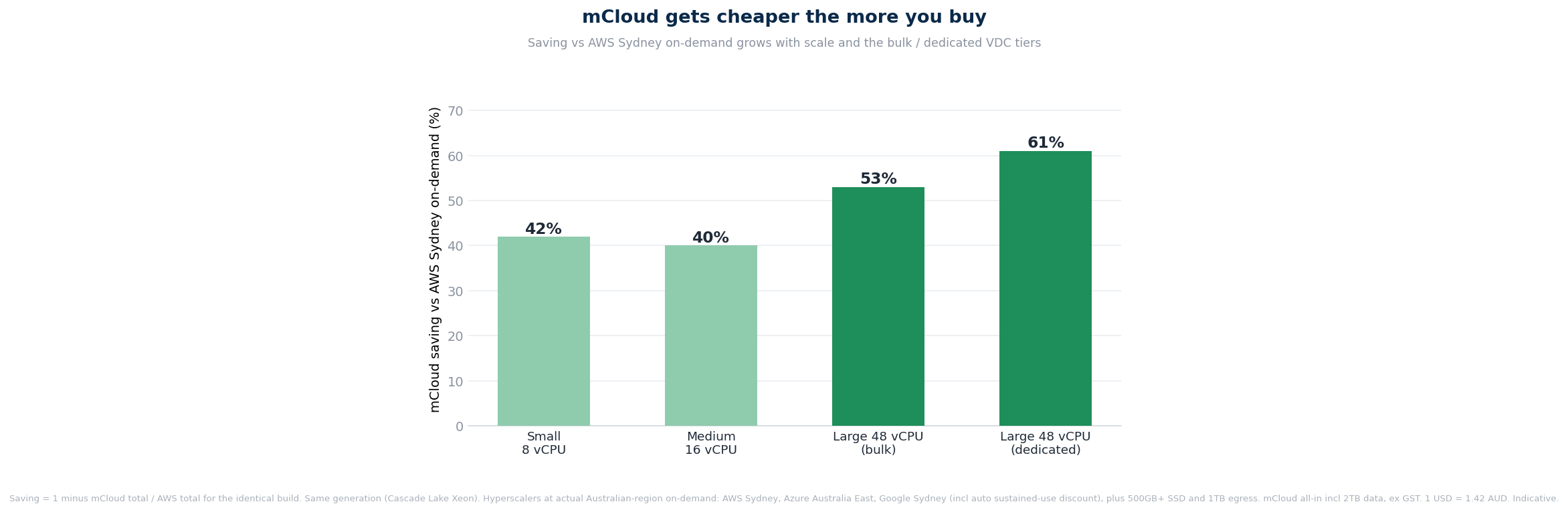
The effect is dramatic at the large end. The 48-core build above is about 53 percent cheaper than AWS on the bulk tier, and on the dedicated tier it falls to roughly A$1,318.00 a month, about 61 percent below the equivalent AWS on-demand cost. The comparison that matters for anyone consolidating real workloads is not a single small VM, where mCloud is already cheaper, but the at-scale picture, where the gap becomes very large.
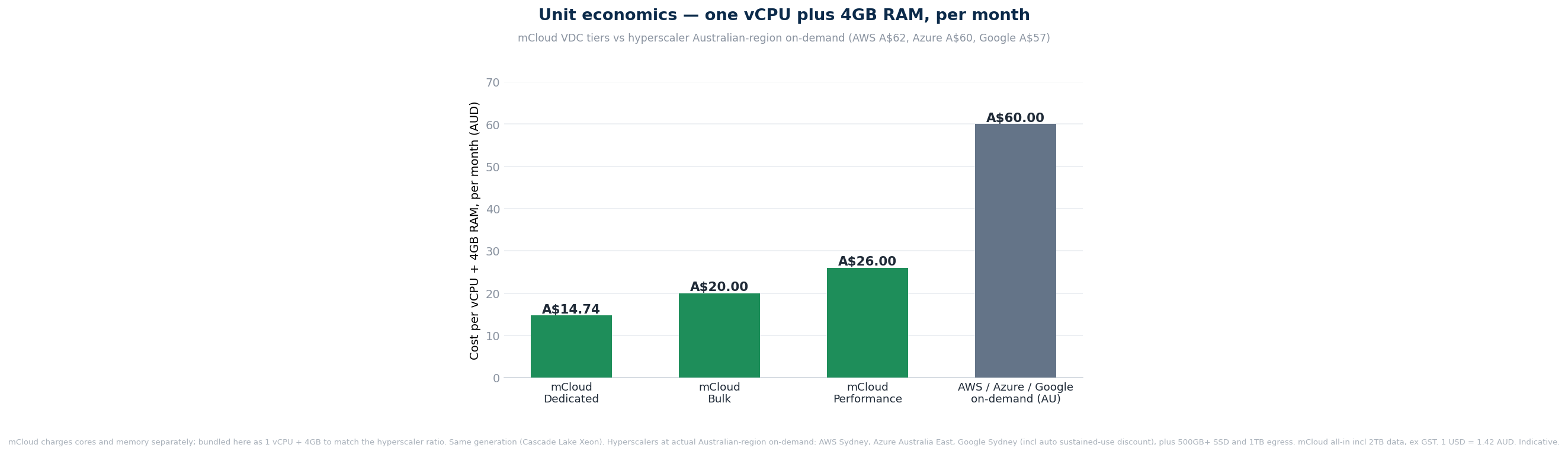
Reduced to a single comparable unit, one virtual CPU plus 4GB of memory, mCloud ranges from A$26.00 a month on the performance tier down to under A$15.00 on the dedicated tier, against roughly A$65.00 for the same unit on a hyperscaler at Australian-region on-demand pricing.
Flexible and still cheaper: mCloud monthly beats even a one-year hyperscaler commitment
Here is the simplest way to see the difference. The hyperscalers only get close to mCloud if you lock yourself in for one or three years. mCloud does not ask for any of that, and its flexible month-to-month price still comes in below the hyperscalers' committed one-year price at every size. In other words, you can stay completely flexible on mCloud, cancel any time, and still pay less than you would on AWS after signing up for a full year.
| Per month, identical build | mCloud (flexible, monthly) | AWS on-demand (monthly) | AWS 1-year committed |
|---|---|---|---|
| Small: 8 vCPU, 32GB, 500GB SSD | A$398.00 | A$682.00 | A$498.00 |
| Medium: 16 vCPU, 64GB, 1TB SSD | A$746.00 | A$1,237.00 | A$868.00 |
| Large: 48 vCPU, 192GB, 2TB SSD | A$1,570.00 | A$3,341.00 | A$2,234.00 |
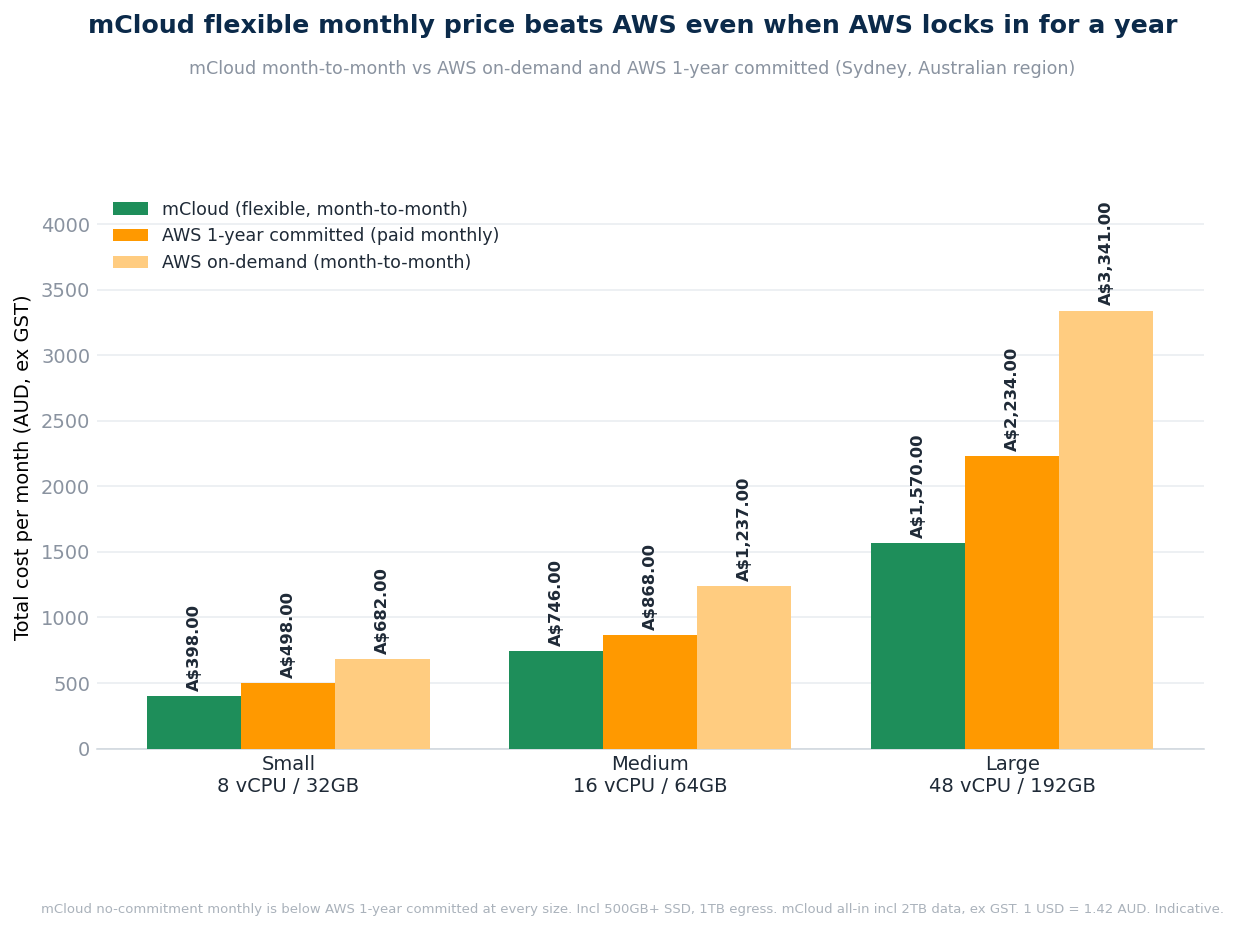
mCloud's no-commitment monthly price is about 20 percent below AWS's one-year committed price on the small build and about 30 percent below it on the large build, and the same holds against Azure and Google: their one-year reserved and committed-use prices still sit above mCloud's flexible monthly rate. You get the lower price without giving up the flexibility.
And if you are happy to commit, mCloud gets cheaper again. A one-year mCloud term, also paid monthly, takes roughly 10 to 20 percent off the monthly rates, bringing the same three builds down to about A$377.00, A$704.00 and A$1,378.00 a month, or about A$1,175.00 for the large build on the dedicated tier. So mCloud wins whether you want maximum flexibility or maximum savings, while the hyperscalers only reach their lower prices by locking you in.
Storage and data, without the traps
Two parts of a hyperscaler bill cause more bill shock than any other: storage metered across several tiers with separate IOPS charges, and egress billed per gigabyte every time data leaves. mCloud handles both plainly. Storage is a flat monthly price across four clearly named types, from high-performance NVMe down to bulk SAS, with no separate IOPS billing. Data is the included 2TB plus simple blocks or an unlimited plan, with none of the per-gigabyte egress metering that makes hyperscaler bills so hard to predict.
Triple redundancy: true multi-region, made simple
There is one capability mCloud offers that the hyperscalers do not match in any straightforward way. For about 30 percent more across any of the options above, mCloud's triple redundancy replicates your virtual instance in real time across three separate Melbourne data centres, our own Tier IV facility plus NextDC and Vocus, with around 0.4 millisecond write latency between sites. If an entire data centre vanished, your instances automatically reboot in another site and keep the same public IP address, so everything fails over cleanly with nothing for you to reconfigure.
The hyperscalers can build cross-region disaster recovery, but only as a service you design, configure and maintain. Azure offers Site Recovery, which replicates and can fail an IP configuration over to another region once you set it up. AWS lets you re-associate an Elastic IP, though private VPC addresses are tied to a single availability zone and cannot move across regions. Google relies on Cloud DNS health checks to reroute traffic to a second region you have built yourself. None of them offer a single-tick, real-time, same-public-IP automatic failover across regions. mCloud has turned what is normally a complex disaster-recovery project into a checkbox.
Instances or virtual data centre: which to choose
For a single server or a small handful, the m1 instances are the simplest path: a fixed size, a fixed price, DDoS protection and an IP address included, ready in minutes. For anything larger, or any environment that will grow, the virtual data centre is almost always the better value, because you buy resources in bulk at the lower tiers and build whatever mix of machines you need, resizing freely. Many customers run both. Either way the underlying hardware, network, DDoS protection and Australian data centre are the same.
Pricing sources and verification
So the figures can be checked, the hyperscaler pricing here was reviewed in June 2026 from the providers' own pricing pages and independent pricing trackers, at Australian-region on-demand rates. Prices change, so confirm the current rate at the source before relying on it.
The figures are actual Australian-region on-demand rates: AWS in Sydney (ap-southeast-2), Azure in Australia East, and Google in Sydney (australia-southeast1, including its automatic sustained-use discount). At review, an 8 vCPU machine listed at about US$350.00/mo on AWS Sydney, US$336.00 on Azure Australia East and US$322.00 on Google Sydney, scaling up from there.
- AWS M5, Sydney (ap-southeast-2): EC2 on-demand pricing, per-region table at aws-pricing.com/m5.2xlarge
- Azure Dv4 / Dsv4, Australia East: VM pricing, Standard_D8s_v4 regional
- Google N2, Sydney (australia-southeast1): Compute Engine pricing, per-region table at gcloud-compute.com/n2-standard-8
Exchange rate: US dollar figures converted at 1 USD = 1.42 AUD (H1 2026 average; range 1.38 to 1.49). Hyperscaler figures are Australian-region on-demand, the genuine month-to-month match for mCloud's no-lock-in billing; a one to three-year commitment would lower hyperscaler prices but removes that flexibility. Hyperscaler monthly figures assume 730 hours; mCloud prices are flat monthly, ex GST. mCloud is billed in Australian dollars and carries no exchange-rate risk.
The bottom line
On matched Cascade Lake hardware and a matched month-to-month basis, mCloud cloud servers are roughly 42 to 47 percent cheaper than AWS, Azure and Google Cloud for a single server, and the saving widens to around 53 to 61 percent once you scale into the virtual data centre's bulk and dedicated tiers. On top of that, mCloud is billed in Australian dollars with no exchange-rate risk, includes data rather than metering egress, keeps everything in an Australian Tier IV facility, and offers genuine one-tick triple-region failover the hyperscalers cannot match simply.
Compare your own workload.
Build it on the mCloud calculator and put the all-in Australian-dollar figure next to your current hyperscaler bill: micron21.com/calculator
